Storage
China's 15th Five-Year New-Type Energy Storage Implementation Plan keeps 300 GW. The changes are duration and payment eligibility
At about 3 hours, 300 GW implies 900 GWh, our calculation, not an official energy target. The plan makes a storage capacity tariff conditional on list-based management.
The National Development and Reform Commission (NDRC, 国家发展改革委) and the National Energy Administration (NEA, 国家能源局) formally issued the Implementation Plan for New-Type Energy Storage in the 15th Five-Year Plan Period (《"十五五"新型储能实施方案》) on 29 October 2026 and posted it on their websites on 13 November 2026. The NDRC notice is numbered 发改能源〔2026〕1565号. It is a formal issuance (印发), not a comment draft. The 300 GW headline is a power figure already on the books in two earlier 2026 plans. This document adds an average duration of "about 3 hours" (3小时左右). At an exact 3.0-hour average, 300 GW would hold 900 GWh, our calculation, not an official energy target or a shipment total. The operational news is who gets paid and how plants are dispatched: a capacity tariff only for listed grid-side independent storage, and reliable-capacity compensation only after the electricity spot market is in continuous operation.
New-type energy storage (新型储能) is the official category that sits beside pumped-hydro storage (抽水蓄能), not inside it. The June 2026 energy-system plan, 发改能源〔2026〕884号, issued on 13 June and posted on 25 June, already said that by 2030 pumped hydro would reach "about 160 GW" and new-type storage would reach 300 GW. The August 2026 power-system plan, 发改能源〔2026〕942号, posted on 3 August, repeated the 300 GW figure, classified it as an indicative (预期性) indicator, and set a 15th Five-Year increment of "about 160 GW." In that plan's indicator table the 2025 starting point is 1.36 亿千瓦, the same 136 GW NEA reported at its 30 January 2026 press conference. This implementation plan, 1565号, says the national fleet is to "reach 300 GW" by 2030, and that new-type storage is to move from a scale-development stage into a market-oriented stage. It attaches no new 预期性 or 约束性 (binding) label of its own. We read 300 GW as a power stock in 2030, consistent with the earlier plans, not as a new headline.
The July 2021 guiding opinion, 发改能源规〔2021〕1051号, already set a 2025 target of "30 GW or more" (3000万千瓦以上) as China moved from early commercialization toward scale. At the end of 2025, NEA reported 136 GW / 351 GWh already in operation, with an average duration of 2.58 hours, up 84% in power from the end of 2024 and "more than 40 times" the level at the end of the 13th Five-Year Plan. The end-2024 official power figure, given in the NDRC/NEA question-and-answer on the 2025 to 2027 action plan, is 7,376 万千瓦, or 73.76 GW. The 2025 addition is about 62 GW, our calculation (136 minus 73.76). The 136 GW outcome is about 4.5 times the 2021 floor of 30 GW, our calculation (136 / 30). The 14th Five-Year target was a floor that the industry went through, but that history does not, by itself, make 300 GW a floor. The 1565号 text says "reach," not "or more."
The intermediate official target is the 2025 to 2027 action plan, 发改能源〔2025〕1144号, issued on 27 August 2025 and posted on 12 September: 180 GW or more by the end of 2027, with "more than 100 GW" of additions over those three years and about 250 billion yuan (约2500亿元) of direct project investment. From 136 GW at end-2025, the 180 GW floor is at least 44 GW over two years, our calculation. As reported on the NEA website on 7 August 2026, quoting Xu Jilin (徐继林), deputy director of NEA's Energy Conservation and Technology Equipment Department, at an NEA press conference, and sourced there to People's Daily Online (人民网), installed new-type storage at the end of June 2026 was 153 GW / 396 GWh, up 61% from a year earlier. That mid-year figure comes from a media report rather than a year-end statistical bulletin. On that reported basis, about 17 GW was added in the first half of 2026, our calculation (153 minus 136), leaving about 27 GW to the 180 GW floor, our calculation, with 18 months then left to the end of 2027. From end-2025, 164 GW remains to 300 GW, our calculation (300 minus 136); from mid-2026, about 147 GW remains, our calculation (300 minus 153). If the 2030 figure is met and not exceeded, those increments are a slower annual pace than 2025. They are not a forecast of shipments or factory output. The 300 GW figure is a national operating stock of new-type storage, of more than one technology, after retirements and conversions. It is not a 2026 to 2030 sales total, and it is not a total addressable market for lithium cells.
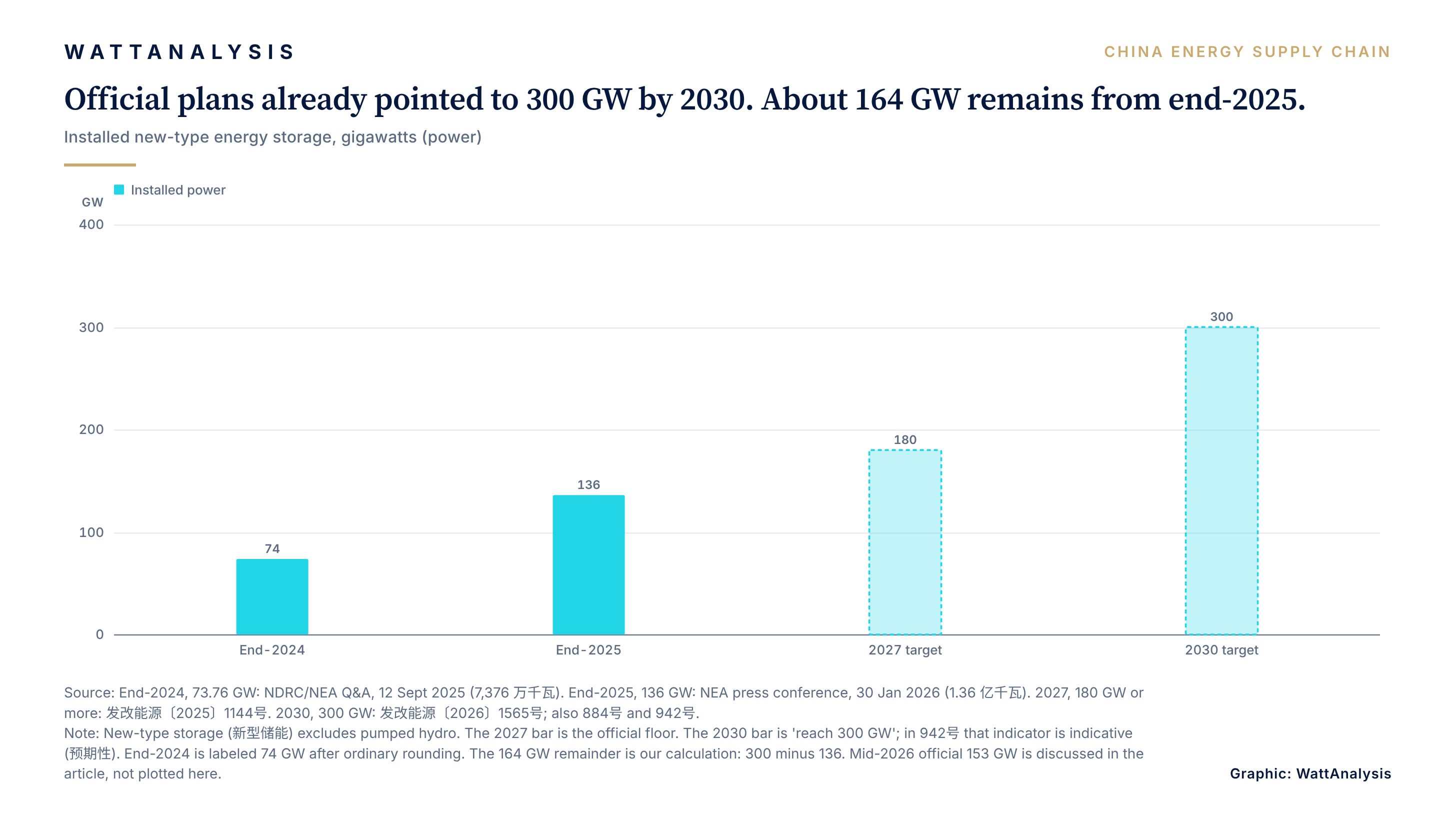
Chart 1 uses only year-end official observations and official targets. The 2027 bar is a floor (180 GW or more), drawn at 180. The 2030 bar is "reach 300 GW." The End-2024 bar is labeled 74 GW after ordinary rounding; the official figure is 73.76 GW. Mid-2026's 153 GW, discussed above, is left off the chart so the series stays with year-end documents.
The duration clause is the one number in 1565号 that the June energy-system plan did not have. The fleet is to have an average duration of "about 3 hours." "About" is in the official text. The plan publishes no gigawatt-hour target.
At the end of 2025, NEA's official pair was 136 GW and 351 GWh, and the stated average was 2.58 hours (351 / 136 = 2.5809, which rounds to 2.58). NEA also said that this average was 0.30 hours higher than at the end of 2024, so the end-2024 average is 2.28 hours, our calculation (2.58 minus 0.30). If the 2030 average were exactly 3.0 hours, 300 GW would hold 900 GWh, our calculation (300 × 3.0). That is an implied stock, at one exact value of a range the plan does not close. If the average were 2.8 hours, the implied stock would be 840 GWh; at 3.2 hours, 960 GWh, our calculation. The rest of this note uses 900 GWh as the exact-3-hour case, labeled as ours.
The step from 2.58 hours to 3.0 hours looks small next to the step from 136 GW to 300 GW. Starting from the official 351 GWh, a 164 GW addition at today's 2.58-hour average would add 423 GWh, our calculation (164 × 2.58 = 423.12, rounded to 423). Raising the whole 300 GW fleet from 2.58 hours to 3.0 hours adds a further 126 GWh, our calculation (300 × 0.42). 351 + 423.12 + 126 = 900.12, which is approximately 900. Most of the implied energy growth is more power. The duration step is about 23% of the 549 GWh implied increment (126 / 549), our calculation, under these assumptions: no retirements, a 164 GW addition, and an exact 3.0-hour average on the whole fleet. If existing plants stayed at 2.58 hours and only new plants brought the fleet average up, those new 164 GW would have to average 3.35 hours, our calculation ((900 minus 351) / 164 = 3.3476, rounded to 3.35). That is a sensitivity, not a plan figure. The document supports upgrades of existing plants that are in a position to be upgraded, but it does not say how much of the duration step will come from new builds and how much from retrofits.
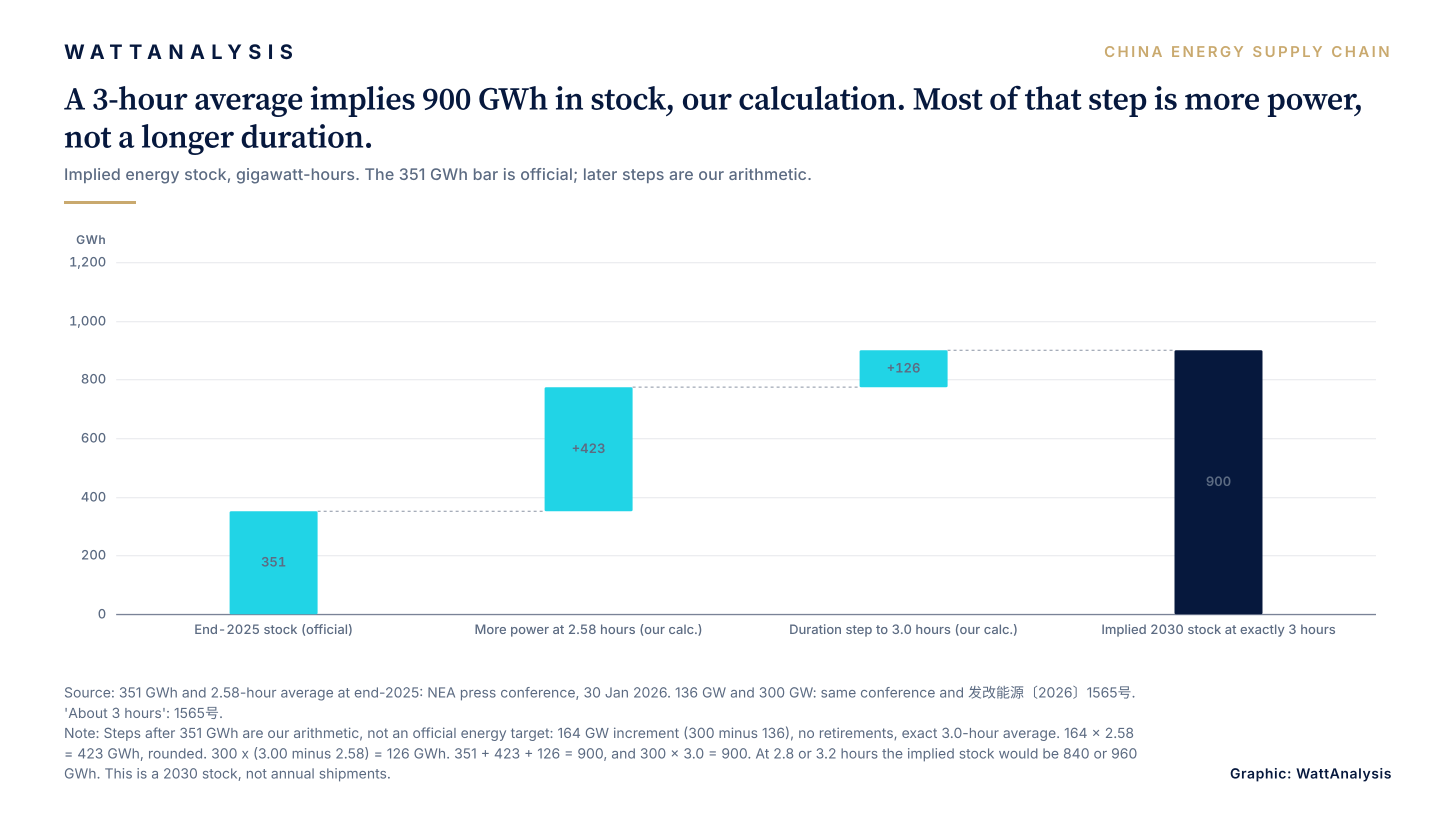
Chart 2 makes that decomposition visible. The opening bar is official; everything after it is our arithmetic. This is a 2030 stock, not annual output or a market forecast.
The 3-hour figure is a fleet average, not a mandate that every project last three hours, and it is not a reliable-capacity credit. The plan says that in the 15th Five-Year period, new-type storage is mainly to meet intra-day regulation needs on the generation, grid and load sides. Cross-day and longer storage of electricity, heat and hydrogen is something the plan says should be "explored" and configured. At the end of 2025, plants of four hours or longer were already 27.6% of installed power, up about 12 percentage points from the end of 2024, according to the same NEA conference. A rising share of longer plants can lift a fleet average without every new plant being a four-hour unit, and without a three-hour nameplate being treated as four hours of accredited peak capacity.
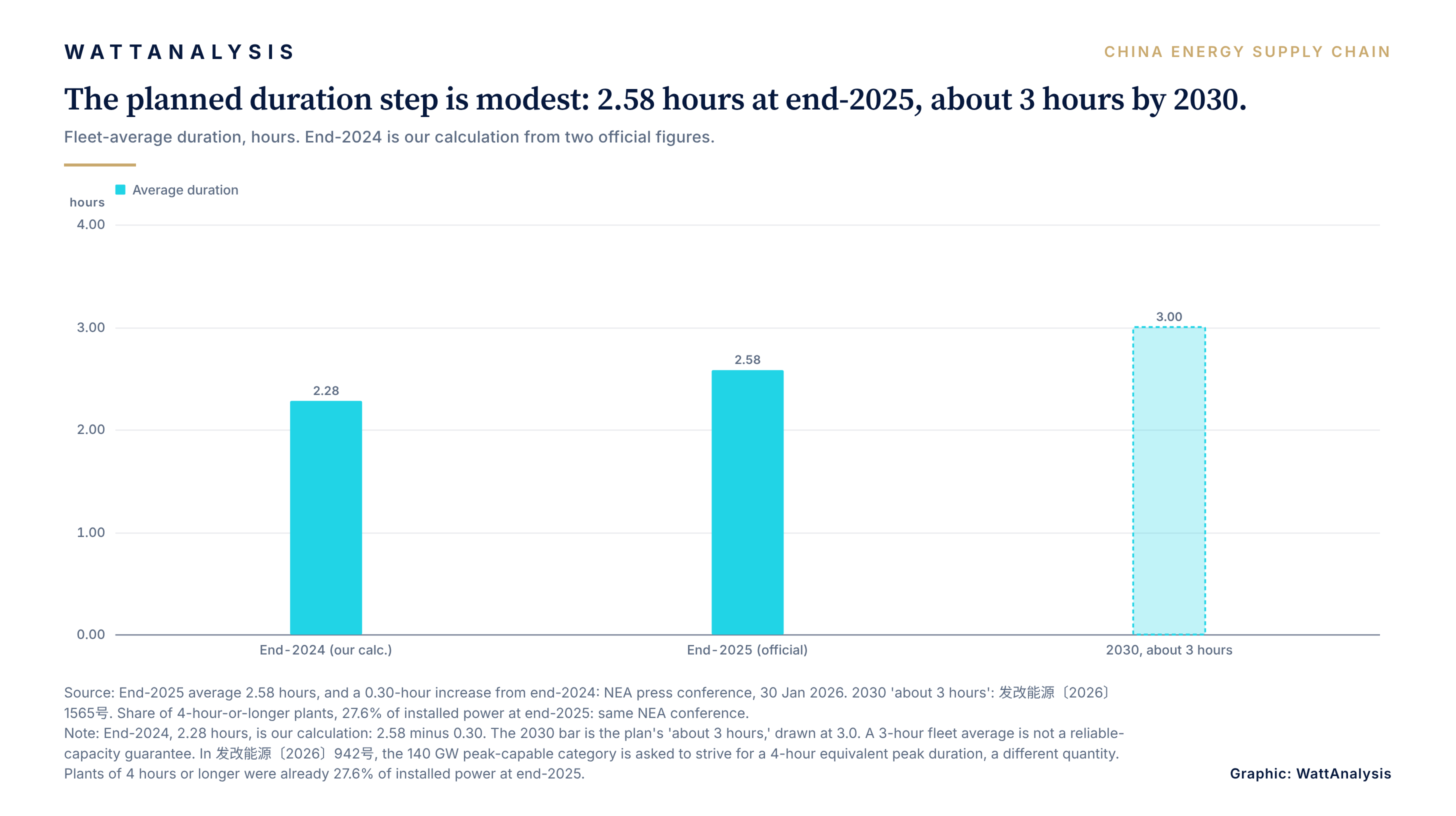
Chart 3 puts the duration step on the same scale as a four-hour line, which the axis reaches but the official average does not. The End-2024 bar, 2.28 hours, is our calculation from the two official figures. The 2030 bar is the plan's "about 3 hours," drawn at 3.0. Equivalent peak duration, discussed in the next section, is not the same as nameplate average duration. A single 3-hour discharge is not a guarantee of reliable capacity.
The fleet is also not all lithium, even though lithium is most of what is already built. At the end of 2025, lithium-ion accounted for 96.1% of installed new-type storage, NEA said, and compressed-air, flow-battery and flywheel storage together for the remaining 3.9%. The implementation plan tells lithium-ion to iterate and upgrade, sodium-ion to be promoted, and compressed-air, flow-battery and flywheel storage to move from pilots toward commercial use. Supercapacitors, compressed-carbon-dioxide, liquid-air, gravity and molten-salt heat storage are encouraged as pilots. Solid-state batteries, heat-pump electricity storage, thermal storage and hydrogen storage are placed in a frontier reserve. A 900 GWh implied stock, if that is what the 3-hour average produces, is therefore not a 900 GWh lithium-cell order book.
Column 2 of the implementation plan says that by 2030, "grid-side independent new-type storage that can undertake a peak-supply role" (可承担顶峰保供作用的电网侧独立新型储能) is to be "about 140 GW." The definition is grid-side, independent, and able to take on peak supply. It is not all grid-side storage, and it is not all independent storage. The same 140 GW, and the same functional wording, already appeared in the August power-system plan, 942号, which also said that during the 15th Five-Year period the country would add "about 80 GW" of this category, and that equivalent peak duration should "strive to reach 4 hours." The implementation plan does not repeat the 80 GW increment or the 4-hour equivalent, but it tells provinces to break down and implement the regional guidance scale already set in the power-system plan, together with electricity-adequacy warnings. We treat 140 GW as a functional 2030 stock that was already official in August, not as a new total, and the 4-hour equivalent peak duration remains the governing language for that category in 942号.
At the end of 2025, independent storage of all kinds, not only the peak-capable grid-side subset, was 51.2% of the national fleet, NEA said, which is about 69.6 GW, our calculation (0.512 × 136). New independent installations in 2025 were 35.43 GW (3,543 万千瓦). Those figures describe a wider set than the 140 GW category. The 80 GW increment in 942号, next to a 140 GW 2030 stock, would imply about 60 GW of this category at the start of the 15th Five-Year period, our arithmetic (140 minus 80). The plans do not themselves publish a 2025 baseline for the peak-capable subset, and that 60 GW remainder is not an official published baseline.
Column 1 says that by 2030, new-type storage "configured at new-energy bases" (新能源基地配置新型储能) is to be "about 50 to 60 GW." The column covers desert, Gobi and barren-land bases (沙戈荒), hydro-wind-solar integrated basins, and offshore wind, including deep-sea energy islands, "as needed." The named onshore bases include Gansu's Badan Jilin, Xinjiang's Taklamakan, the Songliao clean-energy base in the northeast, Inner Mongolia's desert bases, and Qinghai. The hydro-wind-solar list includes the Yalong, upper Jinsha, upper Lancang, southeastern Tibet (Yucha), upper Yellow River in Qinghai, and the middle and lower Jinsha. This 50 to 60 GW is a configuration figure at bases, not a second national total, and not a statement that every megawatt at a base is an independent market unit. The June and August plans already discussed storage at those bases; the 50 to 60 GW range is the specific band this implementation plan adds.
The plan does not add 140 GW and 50 to 60 GW. Adding them would produce 190 to 200 GW, our arithmetic, which is not 300 GW and is not a residual that "proves" a third official bucket. The two figures have different legal and functional definitions. The documents do not present them as a partition of the 300 GW. Even if "grid-side independent" and "configured at a generation base" are distinct project types, the 140 GW is itself a subset defined by a peak-supply role. The rest of the 300 GW includes co-located storage at ordinary renewable plants, storage at coal and retired thermal sites, distribution-level and user-side projects, and any grid-side plants outside the peak-capable independent category. The plan encourages those uses but gives them no separate gigawatt targets in this document.
The 140 GW is also not 140 GW of four-hour lithium. The 4-hour figure in 942号 is an equivalent peak duration to strive for, for that category. How accreditation will work, how much derating a 2-hour or 3-hour plant will take, and which plants get onto the list, are not settled in 1565号.
The payment and dispatch sections should be read as written, not as a national capacity payment for every storage plant.
A capacity tariff for grid-side independent storage is not a new idea. The 2021 guiding opinion already said China should "establish a capacity-tariff mechanism for grid-side independent storage stations." The 2025 to 2027 action plan said authorities should improve capacity tariffs for regulating resources, including new-type storage, and "in an orderly way" establish a reliable-capacity compensation. The August power-system plan, in Column 9, item 4, said the same in slightly different words: improve capacity tariffs for coal, gas, pumped hydro and new-type storage, and establish a reliable-capacity compensation "according to a unified standard," then, when conditions are ripe, explore a market mechanism and, in places that are ready, a capacity market. This implementation plan is more precise about the gate.
Section 12 of 1565号 says: "On the premise of implementing list-based management, establish a capacity-tariff mechanism for grid-side independent new-type storage. After the electricity spot market is in continuous operation, establish a reliable-capacity compensation mechanism in an orderly way, and compensate according to unified principles, so as to guide reasonable investment and efficient use." Section 7, on project management, separately says authorities should "further strengthen list management of grid-side independent new-type storage." The list (清单制) is both a management tool and the premise for the tariff. The plan publishes no list criteria, no yuan-per-kilowatt rate, no national quota of listed megawatts, and no rule that every independent plant will be listed.
The two sentences in section 12 are sequenced. A capacity tariff, for listed grid-side independent plants, is premised on the list. A reliable-capacity compensation comes "after" continuous spot-market operation, "in an orderly way," and "according to unified principles." 1565号 says "unified principles" (统一原则). 942号 said "unified standard" (统一标准). Each document's wording is kept; the two phrases are not treated here as the same legal test. The plan does not say whether the later compensation replaces the tariff, sits on top of it, or applies to a wider set of resources, and those readings are left open. It also does not say that co-located or user-side plants receive either payment. For co-located storage, the text is permissive: "localities may improve co-located storage capacity-leasing markets," so that co-located capacity value can be reasonably reflected. That is a permission, not a national mandate and not a published leasing price.
Energy-market access is written more broadly. The plan says new-type storage should participate fairly in mid- and long-term markets and in the spot market, and that charge and discharge prices should be formed through market trading. Large renewable bases that have storage may participate as a whole in interprovincial mid- and long-term markets. Where local rules allow, co-located storage may participate as an independent market entity. The plan also says price-limit ranges in mid- and long-term and spot markets should be studied and improved, so that there is "room" for storage. It does not set those limits.
Ancillary services are tied to market maturity. In regions where the spot market is already in continuous operation, a frequency-regulation market should be established more quickly, and reserve, ramping and rotational-inertia products should be studied and explored. Storage may take part as an independent station, as an aggregator, or as a virtual power plant. Compensation and cost-allocation rules for ancillary services are to be improved. The plan does not say that these products already exist everywhere, and it gives no nationwide ancillary-service revenue figure.
Dispatch follows the same split. In continuous-spot regions, new-type storage is to be operated according to the market clearing result. In regions where the spot market is not yet in continuous operation, dispatch is to consider both economics and system need. Co-located storage at a generation site may be jointly dispatched with its plant, and the plan supports that. In a system-safety incident, and in other necessary cases, every new-type storage plant under the dispatcher's jurisdiction must accept unified direct dispatch. Existing plants that can be upgraded may be upgraded, with safety first and economics in mind, so that utilization can keep rising. NEA's preliminary figure for 2025 was 1,195 equivalent utilization hours nationally, up by nearly 300 hours from 2024, with 1,175 hours in the State Grid area and 1,294 hours in the China Southern Power Grid area. Those official hours are reported as given. They are not converted into a cycle count, because the official definition of "equivalent utilization hours" for this series is not restated in the 30 January briefing at a level that would support that conversion.
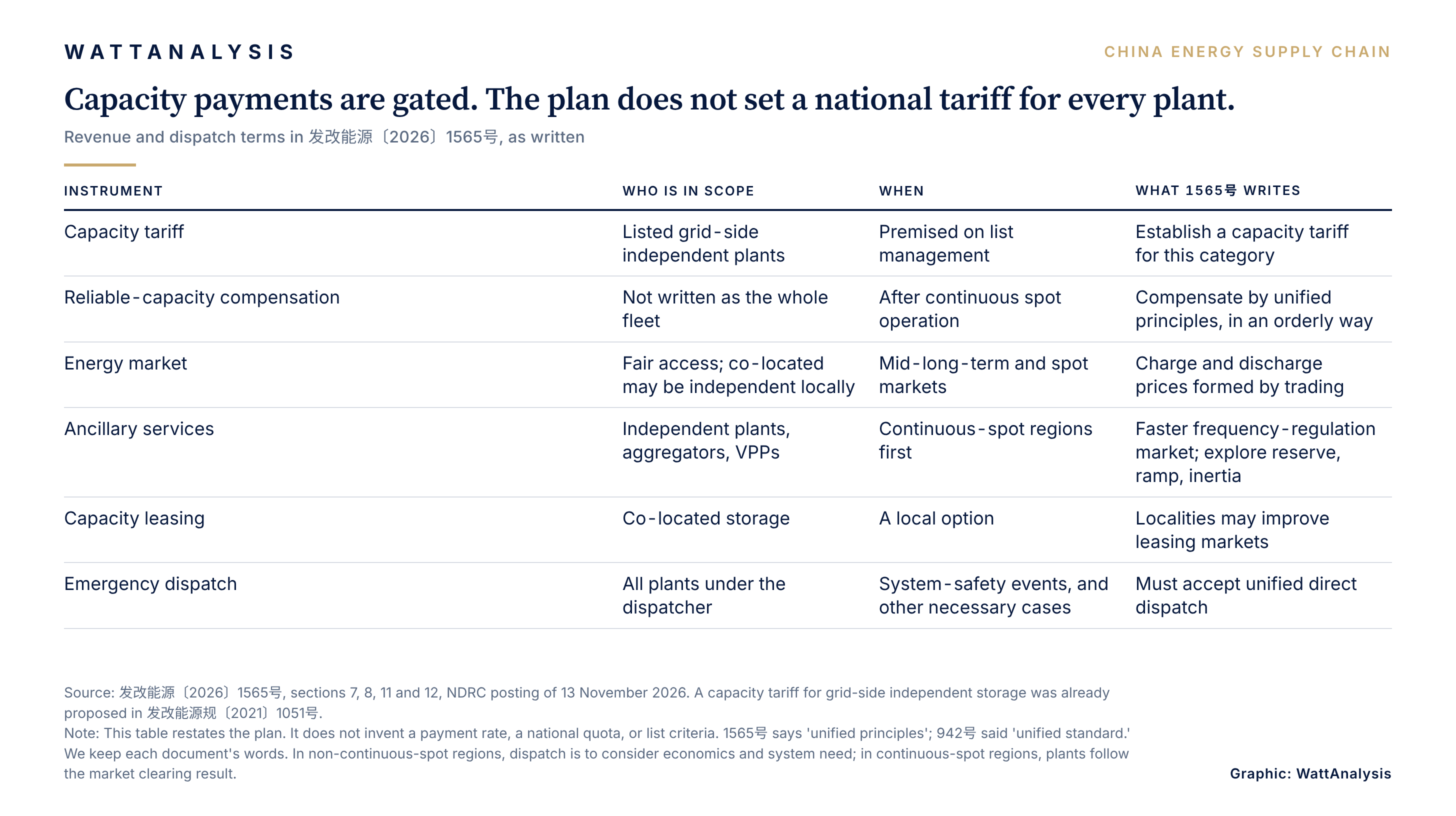
Chart 4 is a restatement of 1565号, not a model of project returns. There is no official national payment rate in this document, and none is supplied here. A developer who treats "capacity tariff" as a revenue line for every megawatt of the 300 GW is reading more than the text supports. A developer who treats the list, and the "after continuous spot" condition, as the actual gates is reading what the ministries wrote. How many megawatts will be listed, in which provinces, at what rate, and from which year, will be decided in later rules and in provincial lists.
The plan is supportive of grid-forming storage (构网型储能), and it is cautious in the same sentences. Grid-forming is to be advanced "actively and steadily," with scene demand as the starting point. Reliability and the ability to support the grid are to be verified. Planning, configuration and equipment standards are to be improved gradually. The places named are where a weak or stressed grid would use that capability: large renewable clusters, sending and receiving ends of transmission corridors, cities whose load has hollowed out, weak grids and islanded grids, and, on the grid-side column, nodes with concentrated renewable connections, dense load, or large DC infeeds. The services listed are peak regulation, frequency, voltage, emergency reserve, ramping and black start. None of that is a gigawatt target, a procurement mandate, or a ranking of inverter makers. Whether grid-forming works at scale is, in the plan's own words, something to be verified.
Data centers are treated the same way. The plan "encourages reasonable configuration" of new-type storage at data centers, to help computing and electricity develop in a coordinated way. A short column on "reliable energy use at computing facilities" points to the eight national computing hubs (Beijing-Tianjin-Hebei, the Yangtze River Delta, the Greater Bay Area, Chengdu-Chongqing, Guizhou, Inner Mongolia, Gansu and Ningxia) and to computing-electricity coordination zones in Qinghai, Xinjiang and Heilongjiang. There, storage plants may be built according to local conditions, and "cluster-shared storage reserve services" may be explored, in order to raise the reliability of electricity supply and to protect data security. That is an encouragement to explore a shared-reserve model. It is not a mandated backup standard or an hours-of-autonomy rule, and it is not a gigawatt target for data-center storage.
On industry structure, the plan is direct about both lithium and discipline. Section 13 says authorities should implement lithium-battery industry regulation, guide storage-battery firms to advance projects in a reasonable and orderly way, and "guard against the risk of blind expansion." Manufacturers are encouraged to improve raw-material security and product quality, and to study a recycling system. Localities may foster industrial clusters according to local conditions, and should "strengthen market judgment and assessment," so that demand guides the industry and capacity is reasonably laid out. This is the plan's own language about orderly expansion. It is not a closure of the lithium route, and it is not a license to read a 300 GW power target, or a 900 GWh implied stock, as a five-year factory-build program.
International cooperation, green finance, policy-based financial instruments, medium- and long-term manufacturing loans, and local-government special bonds are mentioned as support for projects that meet the conditions, and private firms may take part in major science-and-technology programs and in storage investment. Those are instruments, not appropriations in this document, and no yuan total is attached to them here. The 250 billion yuan figure cited earlier belongs to the 2025 to 2027 action plan, not to this 2030 stock.
Several later documents would change how this plan should be read.
If a national or provincial implementing rule set a capacity-tariff rate, a list of eligible plants, and a published list size, the payment section would move from a gate to a number. If listed capacity were a small share of the 140 GW peak-capable category, or of the 300 GW national stock, the tariff would remain a narrow instrument. If it were most of the independent fleet, the opposite would be true. That number is not yet public.
If official rules defined how reliable capacity is accredited, including any derating for plants shorter than four hours, the gap between a 3-hour nameplate average and a 4-hour equivalent peak duration would become a calculable credit, not only a warning. If a later document published a gigawatt-hour target, we would compare it with our 900 GWh calculation rather than treat that calculation as the official goal.
If NEA's next official year-end figures showed the fleet average already near 3 hours, or showed a sharp change in the 4-hour-or-longer share, the "modest duration step" reading would need to be updated. If the 300 GW indicative figure were revised, or restated as a floor or a cap, the gap from 136 GW (or from 153 GW at mid-2026, as reported) would change. If the mid-2026 153 GW / 396 GWh pair is restated, or not confirmed, in a later statistical release, we would drop or replace that mid-year point.
We would also change the payment discussion if continuous spot-market operation were declared, or withdrawn, in a large set of provinces, because that is the official condition for the reliable-capacity compensation. And we would change the technology discussion if official installed-capacity data showed lithium's 96.1% share moving in a way the plan's "iterate lithium, promote sodium, commercialize compressed-air and flow" ladder does not describe.
What would not, by itself, change the reading is a news-cycle claim that "China has set a 900 GWh target" or that "every storage plant will receive a capacity tariff." Neither sentence is in the official text.
Primary sources
Implementation plan, 发改能源〔2026〕1565号.
Joint notice of NDRC and NEA, formally issued (印发) on 29 October 2026 and posted on the websites on 13 November 2026. The NDRC PDF is the 14-page plan body; the document number and the 29 October date sit on the HTML notice. The NEA notice (index 000019705/2026-000183) carries the same issuance date, with a PDF.
Energy-system plan, 发改能源〔2026〕884号.
Issued 13 June 2026, posted 25 June 2026. 2030 new-type storage "reaches 300 GW"; pumped hydro "about 160 GW."
Power-system plan, 发改能源〔2026〕942号.
Posted 3 August 2026. 300 GW as an indicative (预期性) indicator, with a 2025 value of 1.36 亿千瓦; 15th Five-Year increment "about 160 GW"; peak-capable grid-side independent storage, about 80 GW of additions in the period and 140 GW by 2030, equivalent peak duration to "strive to reach 4 hours"; Column 9, item 4, on capacity tariffs and reliable-capacity compensation "according to a unified standard."
2025 to 2027 action plan, 发改能源〔2025〕1144号.
Issued 27 August 2025, posted 12 September 2025. 180 GW or more by end-2027; more than 100 GW of additions in three years; about 250 billion yuan of direct project investment; capacity-tariff and reliable-capacity language. The NDRC/NEA Q&A of 12 September 2025 gives end-2024 installed capacity of 7,376 万千瓦 (73.76 GW).
2021 guiding opinion, 发改能源规〔2021〕1051号.
Posted 23 July 2021. 2025 target of 30 GW or more; 2030 "comprehensive market-oriented development"; already calls for a capacity tariff for grid-side independent storage stations.
NEA press conference, 30 January 2026.
Bian Guangqi (边广琦), deputy director, Energy Conservation and Technology Equipment Department. End-2025: 136 GW / 351 GWh, average 2.58 hours, up 0.30 hours from end-2024, up 84% in power; "more than 40 times" the end of the 13th Five-Year Plan; 72% of capacity in plants of 100 MW or more; 27.6% in plants of 4 hours or longer; independent storage 51.2% of the fleet, 35.43 GW of independent additions in 2025; lithium-ion 96.1%, other routes 3.9%; equivalent utilization 1,195 hours, up nearly 300 hours, State Grid 1,175 and China Southern 1,294.
Mid-2026 installed capacity, as reported.
NEA website, 7 August 2026, sourced to People's Daily Online, quoting Xu Jilin at an NEA press conference: 153 GW / 396 GWh at the end of June 2026, up 61% year on year. Used with that attribution.
Every number in the body is either a figure from a named official notice, plan, or NEA press conference, or arithmetic on those figures, labeled "our calculation" or "our arithmetic." The 900 GWh stock, the 164 GW and 147 GW remainders, the 423 GWh and 126 GWh waterfall steps, the approximately-900 reconciliation (351 + 423.12 + 126 = 900.12), the 2.28-hour end-2024 average, the 3.35-hour implied duration of new builds, the 4.5-times comparison with the 2021 floor, the 69.6 GW independent fleet, and the 840 and 960 GWh sensitivities are all of that second kind. They are not market estimates and not official energy targets.
Briefing figures that appear in some 13 November media reports but not in the 1565号 text, including a 110 GW incremental "provincial self-use" figure, a 240 GW provincial self-use stock, and a description of 300 GW as a "floor," are not used here. Industry-association installed-capacity totals, which use a different methodology from NEA's official series, are also not used.
The mid-2026 153 GW / 396 GWh pair is official in the limited sense that it is reported on the NEA website, quoting an NEA official, but it is a media-sourced page rather than a statistical bulletin or a posted transcript. It is used in the prose, attributed, and left off Chart 1.
"New-type energy storage" throughout excludes pumped hydro, as it does in the official documents. Power is in GW, energy in GWh, duration in hours. 1 亿千瓦 is 100 GW; 1 万千瓦 is 0.01 GW. End-2025 "1.36 亿千瓦 / 3.51 亿千瓦时" is written as 136 GW / 351 GWh, which is the official rounding we follow. Comparisons use the same official series at stated dates.
You can find more of our research at wattanalysis.com.