Research

Notes from along the chain

Every note carries its source on its face: the original Chinese document, the issuing body and the date — checked line by line before publication. That is what the amber badge means, and it is never decorative.

POLICY · FIELD GUIDEVERIFIED

Cross-chain
Decoding Beijing: A Field Guide to Chinese Energy Policy Documents

Every week, Beijing issues documents that move Chinese energy markets: a plan that reprices storage, an announcement that suspends an export control, an opinion that redirects a hundred billion yuan of grid investment. Overseas readers misread them in two opposite ways. The first treats every document with a red-letterhead issuer and a bracketed number as law — a 通知 notice from a ministry is filed as a binding rule with penalties attached. The second notices the words 规划 plan or 指导意见 guiding opinion and files the document as a vision statement, safe to skim. Both readings are wrong. A ministry notice is usually not legislation at all, and carries no penalties of its own — while a "mere" plan can decide whether a storage plant earns capacity revenue, whether a project is approved, and which list a supplier must be on to sell. What decides how hard a document bites is not its tone or its seal. It is where the document sits in China's legal hierarchy, who issued it, and what downstream instruments — approvals, prices, lists, tenders — are wired to it. This note is the reading guide: the ladder of instruments, the issuers, how to decode a document number and its three dates, why meeting readouts are shadows rather than substance, and a five-step check you can run on any document you are handed.

3Dates every document carries — made (成文), published (发布), effective (施行); only the third moves a shipment
1565号The storage implementation plan: made 29 Oct 2026, published 13 Nov 2026 — a fortnight inside the system first
1 sentenceAnnouncement No. 58 of 2026 — the single sentence that kept six export-control announcements suspended

01 · THE TWO MISREADINGSWhy the seal and the title both lie

The "red header means law" error overstates most of what lands in an energy reader's inbox. The great majority of ministry documents in this sector are 行政规范性文件 administrative normative documents — a real legal category, defined by the State Council, that sits below legislation. They bind the administration and, through it, market actors; but they are not 法律 laws or 规章 rules, they cannot by themselves create penalties, and they can be suspended, extended or withdrawn by a later document of the same rank — as our tariffs tracker watched happen in November 2026, when one joint announcement quietly continued the suspension of six export-control announcements that much of the press had reported as in force.

The "plan means vision" error is the expensive one. A 五年规划 Five-Year Plan creates no offence and fines nobody. But the plan system is the conveyor belt of Chinese industrial policy: the national outline is voted on by the National People's Congress, sector plans follow under it, and implementation plans under those — and at each step the language hardens, from strategic intent to named targets to the lists and price mechanisms that decide individual projects' economics. The reader who skips the plan because it is "not binding" misses the document that the binding documents will cite. The two errors share one root: reading a document's form as a verdict, instead of locating it in the system that gives it force.

02 · THE LADDERThree rungs of law, and the large floor beneath them

The legal anchor is the 《中华人民共和国立法法》 Legislation Law of the People's Republic of China, which fixes the hierarchy every other instrument hangs from: the Constitution at the top; then 法律 laws, enacted by the National People's Congress and its Standing Committee; then 行政法规 administrative regulations, issued by the State Council and promulgated by a 国务院令 State Council order signed by the Premier; then 规章 rules — 部门规章 departmental rules issued by ministries within their own remit, decided at a ministerial meeting and published under the minister's signed order, ranking equally with local government rules inside their respective spheres. Below the ladder's last rung sits everything else — and in energy policy, "everything else" is most of the paper.

  • 法律 / 行政法规 / 部门规章 — the legislative rungs. These are the instruments that can set obligations, licences and penalties directly. They are comparatively rare in day-to-day energy news, and they announce themselves formally: a State Council order number on a 条例 regulation, a ministerial order on a rule. When a trade measure matters, look for the regulation standing behind it — the MOFCOM export-control announcements discussed below operate under the State Council's 《两用物项出口管制条例》 Regulations on Export Control of Dual-Use Items, which is what gives the announcements their licensing machinery.
  • 行政规范性文件 — administrative normative documents. The State Council General Office's definition (国办发〔2018〕37号, 2018) is precise: documents — other than administrative regulations, decisions, orders and rules — that an administrative organ formulates and publicly issues under its authority, that bear on the rights and obligations of citizens, legal persons and other organisations, that are generally binding, and that apply repeatedly over a period. Most ministry 通知 and 意见 in the energy sector live here. They are real and they bind in practice — an NEA normative document is how permitting, reporting and market rules actually reach a project — but their force is administrative, they must be publicly issued to count, and a peer document can revise or suspend them.
  • 规划 / 方案 / 意见 — the planning family. 规划 plans, 实施方案 implementation plans, 行动方案 action plans and 指导意见 guiding opinions are policy instruments, not legislation. The 公文处理工作条例 (the 2012 Party-and-state document-handling regulation, 中办发〔2012〕14号) defines 意见 as the form "for presenting views and handling approaches on important questions" — guidance by design. Their force is transmitted, not inherent: through the approval decisions, price documents, catalogues and lists that implementing agencies issue under them. Section 05 traces one plan down the full chain.

03 · THE ISSUERSWho can issue what, and the energy bureau's two hats

Four issuers produce nearly everything an energy reader meets, and the byline is the first classification clue.

  • NDRC — 国家发展和改革委员会 National Development and Reform Commission. The macro-planning ministry: it drafts the Five-Year Plan outline, runs investment approval for major projects, and holds the pricing pen. A document carrying the 发改 code is an NDRC document whatever desk inside it drafted the text.
  • NEA — 国家能源局 National Energy Administration. The energy specialist — and the holder of two hats. Its own charter, published on its site, describes it as a vice-ministerial bureau administered by the NDRC: it drafts energy strategy, plans and industrial policy, but its major plans and policies go to the NDRC for review or approval before they reach the State Council. The same charter gives it a second identity: it carries out the day-to-day work of the 国家能源委员会 National Energy Commission, the high-level energy coordination body. In practice this is why so many energy documents are issued jointly — 国家发展改革委、国家能源局《关于印发……的通知》 — with the NDRC's document code on the cover: the drafting hand is the energy bureau, the issuing authority is the commission above it. Read a joint byline as a sign the document has already cleared the level that could have stopped it.
  • MIIT — 工业和信息化部 Ministry of Industry and Information Technology. The manufacturing ministry: industrial policy, equipment and the industry side of the supply chain — the issuer you meet on manufacturing capacity, product catalogues and industry standards.
  • MEE — 生态环境部 Ministry of Ecology and Environment. The environmental ministry: environmental assessment, emissions and the carbon side of the system. An energy project can clear the NDRC/NEA track and still wait on MEE's.
  • MOFCOM + GACC — 商务部 Ministry of Commerce and 海关总署 General Administration of Customs. Trade measures arrive differently: not as bracket-numbered notices but as 公告 announcements — the document-handling regulation defines 公告 as the form "for announcing important or statutory matters to audiences at home and abroad." Export controls, licensing lists and their suspensions come as sequentially numbered joint announcements, effective as their own text states. Section 06 works one through in full.

One more byline habit: the more issuers on a document, the wider the clearance it has survived — and the slower it was to issue. A single-bureau document can move in weeks; a five-ministry 意见 has usually been negotiated for months, which is why its language is both vaguer and harder to reverse.

04 · READING A NUMBERCode, year, serial — and the three dates

Take 发改能源〔2026〕1565号 apart. 发改 is the issuing authority's document code — the NDRC. 能源 names the drafting desk family inside it: energy. 〔2026〕 is the year of issue. 1565号 is the serial number within that code-and-year — an identifier, carrying no ranking and no meaning beyond itself. The document it labels is the joint NDRC–NEA notice issuing the 《"十五五"新型储能实施方案》 Implementation Plan for New-Type Energy Storage in the 15th Five-Year Plan period. Compare the other codes in this note: 国办发 is the State Council General Office's code (国办发〔2018〕37号 is the normative-documents definition above); 中办发 is the CPC Central Committee General Office's. MOFCOM announcements break the pattern deliberately — 商务部、海关总署公告2026年第58号 carries no bracketed office code, just the year and the announcement serial, because an announcement is addressed to the public rather than circulated inside the administration.

Then the dates — every Chinese policy document has up to three, and conflating them is the commonest factual error in English-language coverage.

  • 成文日期 — the date the document is made. The date printed at the foot of the text, when the issuing organ adopted it. The storage plan is dated 29 October 2026.
  • 发布日期 — the date it is published. The storage plan reached the public on 13 November 2026, a fortnight after it was made. The State Council's normative-documents notice shows the same gap in its own metadata on gov.cn: made 16 May 2018, published 31 May 2018. A document can exist, and be circulating inside the system, before you can read it.
  • 施行日期 — the date it takes effect. This is the only date with legal consequences, and it is whatever the text says it is. Administrative regulations default to 30 days after promulgation unless urgency requires otherwise (《行政法规制定程序条例》 Regulations on Procedures for Formulating Administrative Regulations, revised 2026). Announcements routinely name a future start: MOFCOM/GACC Announcement No. 58 of 2026 was published on 9 November 2026, but the suspension it orders runs from 11 November 2026. "Issued Monday" and "in force Monday" are different claims; only one of them moves a shipment.

05 · SIGNALS AND THEIR SHADOWSMeetings announce, documents oblige

Some of the most market-moving texts in Chinese energy are not documents in the ladder at all. Politburo meetings, plenary sessions of the Central Committee and the December Central Economic Work Conference are known to the public through 新华社 Xinhua readouts and 公报 communiqués — 公报 being itself one of the fifteen official document forms, defined as the vehicle "for publishing important decisions or major matters." A readout tells you the direction of travel in deliberately general language; it creates no obligation a counterparty can be held to. The obligations arrive later, down a chain of real instruments. The current Five-Year Plan cycle shows the whole chain in cross-section:

  • The Party recommends. On 23 October 2025 the Fourth Plenary Session of the 20th Central Committee adopted the 《中共中央关于制定国民经济和社会发展第十五个五年规划的建议》 — the Central Committee's Recommendations for the 15th Five-Year Plan, including the call to "accelerate the building of a new energy system" (加快建设新型能源体系).
  • The legislature adopts. On 12 March 2026 the National People's Congress voted to approve the 《中华人民共和国国民经济和社会发展第十五个五年规划纲要》 — the Outline — converting the Party's recommendation into a state document through legal procedure; the same session passed a National Development Planning Law codifying how such plans are made and approved.
  • The ministries particularise. Under the Outline, the NDRC and NEA issued the sector plans for the new energy system and the new power system, and under those — its own preamble says so — the storage implementation plan, 发改能源〔2026〕1565号.
  • The plan bites through mechanisms. The storage plan's headline — 300 GW of new-type storage by 2030 at an average duration of about three hours — binds no one by itself. Its operative content is the machinery underneath: list-based management of grid-side storage projects, and a capacity-price mechanism for the projects on the list. Whether a given plant earns capacity revenue is decided by the list and the price document, not by the 300 GW.

The December 2025 Central Economic Work Conference is the annual version of the same pattern: its Xinhua readout (the conference sat on 10–11 December 2025) set the tasks for 2026 in general terms, and everything enforceable about it has arrived since as ministry documents. Read readouts for direction and vocabulary — the phrases that survive into ministry texts are the ones that will be funded — and read documents for obligations. Trading the readout as if it were the rule is the signal error; ignoring it because it is "only" a readout is the same error, reversed.

06 · THE CHECKA five-step test, with the announcement that fooled the headlines

  • 1 · Find the original. Locate the document on an official surface: the issuer's own site, the gov.cn policy library, or the State Council Gazette (国务院公报) for regulations — the gazette text is the standard text. If a document is only visible as a screenshot or a media summary, treat every claim about it as provisional. A normative document that was never publicly issued does not meet the State Council's own definition of one.
  • 2 · Classify it. 法律, 行政法规, 部门规章, 规范性文件, 规划/方案/意见, 公告, or meeting readout? The byline, the code and the form word in the title answer this in a minute, and the answer fixes the ceiling on what the document can do.
  • 3 · Read the number and the dates. Decode the 发文字号; then separate the made date, the publication date and the effective date, and work only with the third.
  • 4 · Check its current status. Instruments get suspended, extended, superseded and repealed by later instruments of the same or higher rank. Search the issuer's site for the document's number plus 暂停 (suspension), 延期 (extension) and 废止 (repeal) before relying on it.
  • 5 · Follow the wiring. Ask what cites it and what it cites: the regulation behind the announcement, the price document under the plan, the list under the scheme. Conclude only then.

Step 4 deserves its worked example, because it is live. On 9 October 2025 MOFCOM and the GACC issued a package of export-control announcements — Nos. 55, 56, 57 and 58 of 2025, with MOFCOM's Nos. 61 and 62 — covering, among other things, rare-earth equipment and materials and lithium batteries and artificial-graphite anode materials. Four were scheduled to take effect on 8 November 2025. They never did: Announcement No. 70 of 2025 suspended all six until 10 November 2026. As that date approached, coverage widely assumed the controls were about to bite. On 9 November 2026 the two issuers published Announcement No. 58 of 2026 — one sentence, which our tariffs tracker records verbatim: from 11 November 2026 to 10 January 2027, the six 2025 announcements "continue to be suspended" (继续暂停实施). Nothing was repealed; the control lists and their legal basis stand untouched; only the effective date moved, for the second time. A neighbouring suspension — the gallium, germanium and antimony measures under Announcement No. 72 of 2025 — was not covered and keeps its own expiry of 27 November 2026. Three lessons generalise: a suspension is not a repeal; each announcement runs on its own clock; and the document that decides your shipment is frequently the short, late, boring one that amends the famous one.

That is the discipline this publication applies to every policy claim it prints: the issuer, the number, the rung, the dates and the current status, checked against the original — so that when a document in a counterparty's deck fails step 2 or step 4, you have found the fine print that matters.

The rule, in one sentence

A Chinese policy document's force is fixed by its rung in the legal hierarchy and by the approvals, prices and lists wired to it — never by the colour of its letterhead, the word 规划 in its title, or the headline that announced it.

Primary sources

Legislation Law of the People's Republic of China (full text)

Xinhua authorised release · the hierarchy of laws, administrative regulations and departmental rules that section 02 hangs from

《关于加强行政规范性文件制定和监督管理工作的通知》(国办发〔2018〕37号)

State Council General Office · gov.cn · the official definition of administrative normative documents; the page's own metadata shows the made date (16 May 2018) a fortnight before the publication date (31 May 2018)

《党政机关公文处理工作条例》(中办发〔2012〕14号)

Party-and-state document-handling regulation, 2012 · the fifteen official document forms and their definitions, including 意见 and 公告

《中共中央关于制定国民经济和社会发展第十五个五年规划的建议》

Fourth Plenary Session of the 20th Central Committee · adopted 23 Oct 2025 · gov.cn · the Party's Recommendations opening the chain in section 05

《行政法规制定程序条例》 (revised 2026, State Council Order No. 838)

State Council · gov.cn · promulgation in the State Council Gazette and the 30-day default effective rule

《国家能源局主要职责、内设机构和人员编制规定》 — the NEA's charter

National Energy Administration (nea.gov.cn) · the NEA as a vice-ministerial bureau administered by the NDRC; NDRC review of its major plans; its role carrying out the National Energy Commission's work

《关于印发〈"十五五"新型储能实施方案〉的通知》(发改能源〔2026〕1565号)

NDRC and National Energy Administration · document dated 29 Oct 2026, released 13 Nov 2026 · the worked example for reading a number and its three dates

MOFCOM & GACC Announcement No. 58 of 2026

Ministry of Commerce and General Administration of Customs · 9 Nov 2026 · the one-sentence continuation of the suspension of 2025 Announcements Nos. 55, 56, 57, 58, 61 and 62, from 11 Nov 2026 to 10 Jan 2027 (text verified in verbatim reproductions of the MOFCOM release)
Full note above — free to cite with attributionREADER · FREE

Standalone page ↗

HYDROGEN · DEEP DIVEVERIFIED

Hydrogen
The Hydrogen Number Beijing Hasn't Published

China publishes hydrogen statistics the way it publishes power statistics: in volume, on schedule, and with more route-by-route detail than any other country offers. Total production, total capacity, output split by coal, gas, industrial by-product and electrolysis, project counts, station counts — all of it is in print, in the National Energy Administration's (国家能源局, NEA) annual hydrogen report, now in its 2025 and 2026 editions. One number, however, has never appeared in any of it: how much green hydrogen — hydrogen made by electrolysing water with renewable electricity — China actually produced. The capacity to make it is published to the nearest ten thousand tonnes. The output is not published at all. This note inventories what the official record does contain, isolates the exact line that is missing, and shows why every substitute number in circulation fails to stand in for it.

>250 kt/yrRenewable hydrogen capacity built and commissioned at end-2025 (NEA) — with over 900 kt/yr more under construction
0Official green-hydrogen output figures published for any year — the missing line this note is about
53%China's share of the world's built renewable-electrolysis capacity at end-2025, on the NEA's own global tally

01 · THE LEDGER THAT EXISTSCapacity, counted four ways

Start with what is published, because it is genuinely impressive. For renewable hydrogen — officially 可再生能源制氢, hydrogen produced from renewable energy, in practice mostly 可再生能源电解水制氢, renewable-powered water electrolysis — the NEA prints capacity at four levels of commitment, and keeps them apart.

At end-2024, according to 《中国氢能发展报告(2025)》 (China Hydrogen Development Report (2025)): more than 600 projects 累计规划建设 — planned or under development, cumulatively; more than 90 built 已建成; more than 80 under construction 在建; and built capacity of about 125 kt/yr 已建成产能约12.5万吨/年. During 2024 alone, 35 projects were newly completed, adding about 48 kt/yr of capacity, up about 62% year on year.

A year later the same ledger, from 《中国氢能发展报告(2026)》: built-and-commissioned renewable hydrogen capacity 建成投运产能 exceeded 250 kt/yr at end-2025 — more than double end-2024 — with over 900 kt/yr under construction 在建, and the built-and-under-construction total above 1 Mt/yr. The NEA's April 2026 press conference repeated the pair for end-Q1 2026, unchanged: over 250 kt/yr in operation, over 900 kt/yr being built. By the NEA's own global tally in the 2026 report, world built renewable-electrolysis capacity at end-2025 was only about 500 kt/yr, of which China held 53% and Europe 19%; the largest single project on earth, the Jilin Songyuan green hydrogen–ammonia–methanol complex, carries 45 kt/yr of nameplate.

Every one of those numbers is a capacity: a rate at which plants could produce if run at nameplate, or a count of projects at some stage of existing. None of them is a quantity of hydrogen.

02 · THE OUTPUT THAT IS PUBLISHEDBeijing counts production when it wants to

It would be wrong to say China does not publish hydrogen output. It does — for hydrogen in total, and in remarkable detail. The 2025 report puts 2024 production 产量 at over 36.5 Mt, up about 3.5%, against capacity 产能 of over 50 Mt/yr; the 2026 report puts 2025 production at over 39 Mt, up about 7.3%, against capacity of over 51 Mt/yr. The fossil routes get both sides of the ledger, output beside capacity: in 2024, coal-based hydrogen produced about 20.7 Mt against about 28 Mt/yr of capacity; gas-based about 7.6 Mt against about 10.8 Mt/yr; industrial by-product hydrogen about 7.7 Mt against about 10.7 Mt/yr. Divide the report's own pairs (our arithmetic, on its printed figures) and each fossil route ran at roughly seven-tenths of nameplate.

Even electrolysis — all of it, grid-powered included — received an output line once: about 0.32 Mt produced in 2024, against about 0.5 Mt/yr of electrolysis capacity, up about 3.6%. Less than 1% of national output, but a real, printed production figure.

So the statistical machinery for hydrogen output exists, and the NEA uses it. Which makes the shape of the gap precise: it is not "hydrogen output" that is missing. It is the output of one subset — the renewable subset, the subset the entire policy edifice is built to promote.

03 · THE MISSING LINEThe greener the hydrogen, the thinner the data

For renewable hydrogen, neither edition of the report prints a production figure — not for 2024, not for 2025, not as a total, not as a range. We searched both official PDFs in full text: the production sections give output for coal, gas, methanol (a route broken out for the first time in the 2026 edition) and industrial by-product hydrogen; for electrolysis, the 2026 edition prints no output line at all, and for the renewable subset neither edition prints one in any year. There is likewise no utilisation rate 利用率 and no operating-hours figure for renewable projects anywhere in either edition or in the April 2026 briefing — the variable that converts capacity into output is as unpublished as the output itself.

Our Data section therefore carries green-hydrogen output where it carries every figure the authorities do not print: on the checked-and-withheld list. The entry reads, in full: "Green-hydrogen output: the NEA publishes production capacity, not output; no output figure is published or derived." Capacity is never converted into production on this site, because the conversion factor is exactly what Beijing has not published.

04 · THE TARGET NOBODY CAN SCOREA 2025 goal written in output language

The gap is not an academic one, because the state's own plan is written in the missing unit. The 《氢能产业发展中长期规划(2021—2035年)》 (Medium- and Long-Term Plan for Hydrogen Energy Industry Development (2021–2035)), issued by the National Development and Reform Commission and the NEA in March 2022, set the 2025 goal as follows: 可再生能源制氢量达到10-20万吨/年 — renewable hydrogen production of 100–200 kt/yr by 2025. The character is 量, quantity: a production target, on its face.

Now score it. On a capacity reading, the target was passed comfortably: built renewable capacity stood at about 125 kt/yr at end-2024 — already inside the band — and over 250 kt/yr at end-2025, above its top. On the production reading the plan's own words demand, the target cannot be scored at all: there is no official output figure to set against it, for 2025 or any other year. A five-year plan period has closed with its headline hydrogen goal simultaneously exceeded and unverifiable, depending on which of two quantities the reader silently substitutes for the other. Most coverage substitutes capacity and declares the goal met. The honest sentence is the narrower one: the goal was written in tonnes produced, and tonnes produced is the number that does not exist.

05 · WHY THE NUMBER IS MISSINGNo meter, no series

There is no statistical carrier. China's statistical system reports energy production monthly through the National Bureau of Statistics' 能源生产情况 energy production release — raw coal, crude oil, natural gas, electricity, each with its own section. The September 2026 edition, like every edition before it, contains no hydrogen line. Hydrogen has never been admitted to the release, so no monthly or quarterly official output series exists for hydrogen of any colour.

The annual figures are industry-compiled, not bureau-compiled. The NEA report's own charts carry the footnote 数据来源:国能氢创统计 — "source: Guoneng Hydrogen Innovation statistics" — and the report is compiled by an NEA department together with 国能氢创科技有限责任公司, an industry company; the 2026 edition adds an NDRC department as co-compiler, and the quarterly briefings attribute the renewable figures to 全国氢能信息平台统计, statistics of the National Hydrogen Information Platform. Project platforms and industry compilers register projects: nameplates, groundbreakings, commissioning dates. They are not wired to production meters, and their publications faithfully reflect that — rich in capacity, silent on flow.

Most hydrogen never crosses a readable meter. The 2025 report's consumption split shows where hydrogen goes: synthetic methanol took about 9.95 Mt in 2024 (27% of consumption), synthetic ammonia about 9.5 Mt (26%), refining about 6 Mt (16%), coal chemicals about 4.05 Mt (11%). This is overwhelmingly captive production — made and consumed inside the same industrial fence, often inside the same plant. There is no grid to meter it at the boundary, as there is for electricity, and no market transaction to record, as there is for coal or gas.

The definition of "green" is still being plumbed. What qualifies as renewable hydrogen — dedicated renewable plant, grid-connected project buying green power, something in between — determines what an output figure would even count. The accounting arrived only in December 2025, when the Ministry of Ecology and Environment and the NEA issued the CCER methodology 《温室气体自愿减排项目方法学 可再生能源电解水制氢》 (CCER—01—004—V01), under which a green-hydrogen project may register carbon credits only if at least 90% of its electricity comes from its own renewable plant and its monitoring data are linked to the national carbon-market platform. Read that condition again: the first instrument that will ever produce audited, metered green-hydrogen output in China is a voluntary carbon-credit methodology, published at the end of 2025, covering only projects that opt in.

06 · THE PROXIESFour substitutes, four failure modes

  • Capacity × assumed hours. Multiply 250 kt/yr by an assumed utilisation and an output appears — along with the assumption, which does all the work. Variable renewables, offtake shortages and demonstration-scale operation all push real running hours far below nameplate convention, and the NEA publishes no utilisation to discipline the guess. Its April 2026 briefing describes the operating fleet in terms that should end the practice: commissioned projects average about 4,900 t/yr apiece, and more than half of them are at or below 1,000 t/yr — a pilot fleet, eight projects of 10 kt/yr or more notwithstanding. A fleet of pilots does not run at the hours of a baseload chemical plant, and no published figure says how it does run.
  • Electrolyser shipments and factory capacity. Numbers for Chinese electrolyser shipments circulate from commercial research firms, but no official series exists: neither edition of the NEA report prints a national shipment total or a manufacturing-capacity total for electrolysers (we searched both texts; the word 出货, shipments, does not appear). Shipments in any case count boxes leaving factories — including exports, inventory and units never installed — which is two removes from hydrogen produced.
  • Project counts. The report's own ladder refutes this one: over 600 projects planned against over 90 built at end-2024. Announcement counts measure press releases and local-government ambition; even the built count measures an event (completion), not an operation.
  • Electricity-side inference. If renewable power consumed by electrolysis were separately metered and published, output could be bounded from the power side. It is not: no such series appears in the NEA's power statistics or its hydrogen publications, and the CCER methodology's insistence on platform-linked monitoring for credit-claiming projects is an admission that, outside them, the metering is not there to read.

07 · TWO COUNTS OF ONE STATIONThe small version of the same problem

If the missing output were an isolated gap, it might be an oversight. The station count suggests something more systemic: even hydrogen's most countable physical asset carries two official-grade numbers that do not meet.

For end-2024, the NEA report's foreword states that China had built over 540 hydrogen refuelling stations 建成加氢站超540座. The industry white paper 《中国燃料电池汽车产业发展白皮书(2025年)》 (China Fuel Cell Vehicle Industry Development White Paper (2025)), published by the Xiangchenghui research institute 香橙会研究院 in March 2025, states on page 138 that China had built 442 stations 截至2024年我国共建成加氢站442座 — about a hundred fewer, a gap of more than a fifth. Neither source prints a definition of what 建成, "built", includes — completed, commissioned, licensed, operating — that would let a reader reconcile them. Our archive therefore files both, in parallel, and adjudicates neither; the NEA's figure has since moved on (over 590 stations at end-2025, per the 2026 report) while the definitional question stays exactly where it was.

A station is concrete, licensed and visible from the road. If two competent counts of stations diverge by a fifth with no published definition to close the gap, a production flow that nobody meters will not be settled by anyone's estimate. It will be settled, if at all, by publication.

08 · WHAT "WORLD'S LARGEST" CAN MEANA grey crown and a green capacity share

Two claims travel under the headline "world's largest hydrogen producer", and the sources support exactly one and a half of them.

For hydrogen in total, the crown is real and it is the NEA's own: the 2025 report's foreword states that China's 2024 production-and-consumption scale of over 36.5 Mt 位列世界第一位 — ranked first in the world — and the 2026 report puts China's over 39 Mt inside a global total of about 109 Mt for 2025. But that crown is grey: coal alone supplied about 23 Mt of the 2025 output, and electrolysis of any kind supplied, on the last printed figure, under 1%. "World's largest hydrogen producer" is a statement about the world's largest coal-to-hydrogen fleet.

For green hydrogen, the verified claim is a capacity share: 53% of the world's built renewable-electrolysis capacity at end-2025, on the NEA's own global tally — the largest fleet of green-hydrogen plant, by nameplate, on earth. The step from that sentence to "world's largest green-hydrogen producer" crosses the exact gap this note is about. Production rankings are decided by utilisation, the unpublished variable; a fleet of many small pilots (section 06) and a fleet of fewer, harder-run plants can hold identical nameplates and produce very different tonnages. The correct statement is not that China's green output ranking is lower than claimed, or higher. It is that no published figure constructs it — for China, the ranking is currently unknowable from official sources, and any league table that prints one has manufactured its decisive input.

09 · THE CITATIONHow to cite it, in both directions

Copy-ready, positive form:

"China's built-and-commissioned renewable hydrogen production capacity exceeded 250 kt/yr at end-2025, with over 900 kt/yr under construction." — National Energy Administration 国家能源局, 《中国氢能发展报告(2026)》 (China Hydrogen Development Report (2026)), August 2026.

And the negative form, which is the one that keeps a publication honest:

"China does not publish green-hydrogen output. No official figure exists for renewable hydrogen actually produced in any year; published figures are production capacity and must not be cited as production."
  • Keep 投运 in the meaning, not just the word. 建成投运 is "built and put into operation" — a commissioning status, an event. It certifies that a plant has started, not how much it has made.
  • Never let a capacity wear an output's grammar. "China produced 250 kt of green hydrogen" is not a loose version of the NEA's sentence; it is a different, unsupported claim.
  • Date the stock. Capacity figures are end-of-period stocks (end-2024, end-2025, end-Q1 2026); compare them only at matched dates.

10 · THE WATCH LISTWhat would change this picture

Four publications would each move the missing number closer to print, and they — not coverage of them — are what to watch. First, the 2027 edition of the NEA's hydrogen report: the tell is whether a 产量 output line ever appears beside 可再生能源制氢, as it already does for every fossil route. Second, registrations and credit issuance under the December 2025 CCER methodology: projects that opt in must link monitoring data to the national carbon platform, producing the first audited, metered green-hydrogen output data in China — partial and self-selected, but real. Third, the National Bureau of Statistics' monthly energy production release: a hydrogen line there would admit hydrogen to the statistical system proper, with an above-scale enterprise reporting frame behind it. Fourth, the NEA's quarterly briefings: the renewable-hydrogen slot currently reports capacity from the National Hydrogen Information Platform; if an output figure ever joins it, the series will have changed character.

Until one of those happens, our Data section will keep the entry where it is — checked, withheld, and never derived. The capacity ledger will keep doubling on schedule. The production line will stay blank, and the blank is the finding.

The answer, in one paragraph

China publishes green-hydrogen capacity in four grades — planned, under construction, built, commissioned — and the commissioned figure more than doubled in 2025 to over 250 kt/yr, 53% of the world total. What it has never published is green-hydrogen output: not one tonne of production appears for the renewable subset in either edition of the NEA's hydrogen report, even as fossil-route output is printed to the nearest ten thousand tonnes. The state's own 2025 target was written in production language and cannot be scored; the four proxies readers substitute for the missing number each fail in a specific way; and the citation forms that keep capacity and production apart are the only honest way to quote the ledger that exists.

Primary sources

《中国氢能发展报告(2025)》 — China Hydrogen Development Report (2025)

National Energy Administration, with Guoneng Hydrogen Innovation Technology Co. · total and route output/capacity for 2024; renewable project ladder and built capacity; stations over 540; "ranked first in the world" (nea.gov.cn PDF, read in full text)

《中国氢能发展报告(2026)》 — China Hydrogen Development Report (2026)

National Energy Administration · 2025 output over 39 Mt and route detail; renewable commissioned capacity over 250 kt/yr, over 900 kt/yr under construction; global renewable-electrolysis capacity ~500 kt/yr with China at 53%; stations over 590 at end-2025; the December 2025 CCER methodology (nea.gov.cn PDF, read in full text)

NEA press conference transcript, 27 Apr 2026

National Energy Administration (nea.gov.cn) · renewable hydrogen at end-Q1 2026; operating projects average ~4,900 t/yr, more than half at or below 1,000 t/yr

《氢能产业发展中长期规划(2021—2035年)》 — Medium- and Long-Term Plan for Hydrogen Energy Industry Development (2021–2035)

NDRC and National Energy Administration · Mar 2022 · the 2025 target of 100–200 kt/yr written as renewable hydrogen production (制氢量)

《2026年9月份能源生产情况》 — Energy Production, September 2026

National Bureau of Statistics · 19 Oct 2026 · the release's structure — coal, crude oil, natural gas, electricity — contains no hydrogen line

《中国燃料电池汽车产业发展白皮书(2025年)》 — China Fuel Cell Vehicle Industry Development White Paper (2025)

Xiangchenghui Research Institute 香橙会研究院 · Mar 2025, §5.2, p. 138 · 442 stations built as of end-2024 — filed in parallel with the NEA's 540+, neither adjudicated

Full note above — free to cite with attributionREADER · FREE

Standalone page ↗

SOLAR · DEEP DIVEVERIFIED

Solar
Solar's Glut, Verified: Capacity, Output and Installations Are Three Different Numbers

Almost every English-language account of China's solar "overcapacity" quotes a single comparison: factories that can make more than a thousand gigawatts of modules a year, set against a world that installs roughly six hundred. The ratio is real, and it is also the wrong number for almost every decision it is used to support — because the thousand and the six hundred do not measure the same thing, and between them sit two more numbers that the coverage routinely skips. Chinese statistics keep the three apart with three different words. Capacity (产能, nameplate) is what the industry's furnaces and lines could produce in a year if they ran flat out. Output (产量) is what they actually produced. Installations (新增装机, new grid-connected capacity) is what got built and connected. The glut lives in the gaps between those three numbers — and the gaps are not the same size, do not move for the same reasons, and do not imply the same thing for a buyer, an investor or a policymaker. This note reads the three series from their primary sources — the China Photovoltaic Industry Association (CPIA, 中国光伏行业协会) for the first two, the National Energy Administration (NEA, 国家能源局) for the third — and shows what each one actually counts.

>1,100 GWModule nameplate capacity at end-2025 (CPIA) — against ~612 GW of expected global installations in 2026
38–56%Implied 2025 running rates by chain link — our arithmetic on CPIA's printed capacity and output figures
315.07 GWNet solar additions in 2025 (NEA) — followed by 72.07 GW in H1 2026, down 66.04%, as the deadline rush annualised out

01 · THREE NUMBERSThree series, three publishers, three different verbs

Start with who publishes what, because in this industry the publisher is part of the definition. Manufacturing capacity and output come from the CPIA, the industry association whose annual roadmap — 《中国光伏产业发展路线图(2025–2026年)》, the China PV Industry Development Roadmap (2025–2026), compiled with the China Center for Information Industry Development (赛迪智库集成电路研究所) under the guidance of the Ministry of Industry and Information Technology's electronics department (工业和信息化部电子信息司) — is the reference document for the supply side. Installations come from the NEA, which counts grid connections, not factory gates: its monthly power-statistics releases (全国电力统计数据) and its annual renewables grid-connection reports (可再生能源并网运行情况). Exports sit in between, recorded by customs and summarised in CPIA's seminar reporting.

The units already tell you the three series are not interchangeable. Polysilicon is counted in tonnes; wafers, cells and modules in gigawatts. And the module gigawatt is a DC nameplate rating — the sum of the panels' rated peak output — while the NEA counts a solar plant in the same table as coal and nuclear plants rated in AC terms. A gigawatt of solar in the NEA's capacity table is not a gigawatt of coal, and a gigawatt of module capacity in CPIA's table is not a gigawatt of anything until someone builds a plant with it. English coverage that lines the three up on one axis has already made its first error before reaching the numbers.

02 · CAPACITYThe nameplate: what could be made, if every line ran

CPIA's February 2026 outlook seminar put China's end-2025 nameplate capacity at more than 3.5 million tonnes of polysilicon, more than 1,500 GW of wafers, more than 1,400 GW of cells and more than 1,100 GW of modules — three to six times the end-2020 levels (polysilicon had been 460,000 tonnes, wafers 240 GW), and 96%, 96.2%, 91.3% and 80.1% respectively of the world's capacity at each link. These are the figures behind every "China can make twice what the world needs" headline, and as far as they go, they are correctly sourced. What they count deserves more care than they usually get.

Nameplate capacity is a stock of potential. It counts every line that exists, whether or not it ran last year: mothballed lines, lines producing last generation's product, lines whose owners have stopped feeding them. It assumes full-rate, full-year operation that no real plant sustains. And it is measured against a demand figure that is itself an installation forecast: CPIA's own July 2026 update expects 612 GW of new installations worldwide in 2026 — so China's module nameplate alone is roughly 1.8 times the entire world's expected build (our arithmetic on CPIA's two numbers). That ratio is a statement about how much building-out happened in 2021–2023, when capacity at every link tripled or more in three years. It is not a statement about how much product will reach a market this year. For that, you need the second number.

03 · OUTPUTWhat the furnaces actually made — and the wedge where the glut lives

The CPIA roadmap records 2025 output of 1.34 million tonnes of polysilicon (down 26.4% year on year), about 680 GW of wafers (down 9.7%), more than 660 GW of cells (up 0.9%) and more than 620 GW of crystalline-silicon modules (up 5.4%). Set output against the end-2025 nameplate and the implied running rates are roughly 38% for polysilicon, 45% for wafers, 47% for cells and 56% for modules — our arithmetic, offered as an approximation (the capacity figure is an end-year stock, the output a full-year flow), and consistent with the utilisation rates CPIA itself reported for the first half of 2025: 38.7% for wafers, 45.7% for cells, 48.3% for modules. In other words, the industry's answer to a 1,100 GW nameplate was to run it at about half speed. The first half of 2026 shows the adjustment deepening: CPIA's July seminar reported output of 538,000 tonnes of polysilicon (down 9.8%), 293 GW of wafers (down 7.3%), 260.7 GW of cells (down 21.9%) and 201.3 GW of modules (down 35.1%) — module output annualising to roughly 400 GW against that same 1,100 GW-plus nameplate, a running rate near 37%.

This wedge — capacity minus output — is where the economics of the glut actually live. It is why the same industry can be simultaneously "twice oversupplied" on paper and a hard negotiator in practice: the marginal gigawatt in the capacity figure belongs to a line that is idle, obsolete or both, and it will not be offered to your procurement tender at any price. It is also the number that policy is now aimed at. The exit route Beijing has chosen runs through standards rather than quotas: three mandatory national standards published in June–July 2026 — energy-consumption limits for polysilicon and monocrystalline silicon, and efficiency limits for modules and inverters, effective 1 January 2027 — which, on estimates presented at CPIA's July seminar, could retire 25–60% of backward polysilicon capacity, around 30% of monocrystalline-silicon capacity and about 20% of module capacity. Nameplate, in other words, is about to be edited downwards by regulation. Anyone quoting the 1,100 GW figure in 2027 without asking what the standards removed will be quoting a ghost.

04 · INSTALLATIONSThe demand side runs on a policy clock, not a market one

The third number is the one the other two ultimately serve, and it is the one most often misread abroad — because in China it is set by policy timing as much as by demand. The NEA's power-statistics series records 315.07 GW of net solar additions in 2025, taking the cumulative fleet past 1,200 GW (1,201.73 GW at end-2025). The NEA's own renewables grid-connection report gives the same year a slightly different cut — 317 GW of photovoltaic additions (164 GW centralised, 153 GW distributed), cumulative PV of 1,200 GW — a small, unexplained divergence between two series from the same agency, and a useful reminder that even "the" installation number carries a series label: one is the net change in the capacity stock, the other a count of connections on a PV-only basis.

What happened next is the cleanest illustration in the dataset of why annual installation figures cannot be read as demand. The pricing reform notice 《关于深化新能源上网电价市场化改革 促进新能源高质量发展的通知》 (发改价格〔2025〕136号, NDRC and NEA, January 2025) split projects at 1 June 2025: plants connected before the line kept a guaranteed mechanism price; everything after sells into the market, with a competitively auctioned mechanism price on top. A companion rule for distributed PV (《分布式光伏发电开发建设管理办法》, 国能发新能规〔2025〕7号) grandfathered projects filed and connected before 1 May 2025. The industry did the obvious thing and connected everything it could before the deadlines: NEA figures put first-half 2025 additions at about 212 GW, and CPIA's Wang Bohua has given the pulse's shape for commercial-and-industrial distributed projects — 55.92 GW connected in the second quarter of 2025, against 6.32 GW in the third. Then came the payback. First-half 2026 additions were 72.07 GW, down 66.04% year on year (NEA, 22 July 2026) — a collapse in the headline rate that is, in substance, a return to trend: Wang Bohua noted at the July seminar that the first-half figure sits around the 2021–2024 first-half average. By September 2026 the cumulative numbers had resumed their climb: 110.83 GW added in January–September, cumulative solar capacity of 1,312.87 GW, up 16.5% year on year (NEA, 26 October 2026), in a fleet that had already passed coal in July to become the country's largest source of installed capacity. Note, finally, the basis trap for forecasters: CPIA's 2026 installation forecast for China is 180–240 GW, while BloombergNEF's analyst put the same year at about 264 GW explicitly on an AC basis, as reported from a February 2026 industry forum — two reputable numbers for the same year, printed on different sides of the inverter, and routinely compared in English coverage as if they were the same quantity.

05 · EXPORTSThe fourth number, and the one that changed by decree on 1 April 2026

Module output has only three places to go: domestic installations, exports, or inventory. In the first half of 2026, with domestic installations at 72 GW and module output at 201.3 GW, exports were the industry's main release valve — and even they need reading twice. CPIA's July seminar reported first-half PV exports of $17.183 billion, up 24.3% year on year, with export volumes moving in three different directions at once: wafers down 0.6%, cells up 36.8%, modules down 2.5% — and the module export value rising for the first time since the second half of 2023. A value series rising while the volume series falls is a price and mix story, not a demand story; and trade-press reporting of the customs data attributes the first-half value growth almost entirely to a rush to ship before a deadline. That deadline was fiscal, not commercial: 《财政部 税务总局公告2026年第2号》 (Ministry of Finance and State Taxation Administration Announcement No. 2 of 2026, 8 January 2026) cancelled the export VAT rebate on photovoltaic products from 1 April 2026 — 249 product lines, assessed by the export date on the customs declaration — with battery rebates cut from 9% to 6% over the rest of 2026 and abolished from 1 January 2027. Exporters pulled shipments into the first quarter; the "growth" in the half-year export value is substantially that pull-forward, and the same notice is a standing headwind for every quarter that follows it.

06 · WHAT IT MEANSFor procurement and strategy readers: which number to use, when

  • Never quote an "overcapacity" ratio without naming both series. Capacity ÷ installations (~1,100 GW against ~612 GW of expected global build) measures the 2021–2023 construction boom. Output ÷ installations measures this year's market. They differ by a factor of about two, and they support opposite negotiating postures.
  • For supply security and pricing, work from output and utilisation, by link. The chain's tightest link is not the one with the biggest nameplate. Polysilicon ran at roughly 38% of nameplate in 2025 against global demand that CPIA-based reporting puts at around 1.2 million tonnes — deep surplus, but concentrated in lines the new energy-consumption standard is designed to close. Watch output and the standards' enforcement, not the capacity total.
  • Treat Chinese installations as policy-clocked. The 2025 figure (315–317 GW, depending on the NEA series) contains a deadline rush worth roughly a normal half-year of demand; the 2026 "collapse" is mostly that rush annualising out. For demand planning, the NEA's monthly series and the provincial mechanism-price auction results are the live indicators — not any single year's total.
  • Check the basis before comparing any two solar numbers. DC nameplate or AC? Net stock change or gross connections? 太阳能发电 (including solar thermal) or 光伏 alone? The two NEA series differ by ~2 GW on the same year; the CPIA and BNEF 2026 forecasts differ in basis before they differ in judgement.
  • Exports are now a policy variable too. After 1 April 2026, Chinese PV export prices carry no VAT rebate; first-half export values flatter the underlying volumes. Contract pricing that assumes pre-April export economics is working from a repealed rule.

The answer, in one paragraph

China's solar glut is real, but it is a gap between three numbers, not one number. Factories carry nameplate capacity of more than 1,100 GW of modules (and 1,400–1,500 GW of cells and wafers) against roughly 612 GW of expected global installations in 2026 — yet the industry ran that nameplate at about half speed in 2025 (620 GW of modules actually produced) and nearer a third in early 2026, while installations themselves swung from a policy-driven 315 GW in 2025 to a 72 GW first half in 2026 that merely matches the pre-rush trend. Capacity tells you what was built in the boom; output tells you what the market is actually being offered; installations tell you what policy deadlines, not just demand, have scheduled. Quote the one your decision turns on — and name it.

Primary sources

《中国光伏产业发展路线图(2025–2026年)》 — China PV Industry Development Roadmap (2025–2026)

China Photovoltaic Industry Association with CCID's Institute of Integrated Circuits, guided by MIIT's Department of Electronic Information · 4 Feb 2026 · 2025 output by chain link; 2025 installations as recorded by the NEA; efficiency benchmarks

CPIA 2026 mid-year seminar — remarks by Wang Bohua, Ningbo, 23 Jul 2026

China Photovoltaic Industry Association · H1 2026 output by link; H1 2026 export value and volumes; 612 GW global 2026 installation forecast; the 2021–2024 comparison for installations

CPIA 2025 review and 2026 outlook seminar — remarks by Wang Bohua, Beijing, 4–5 Feb 2026

China Photovoltaic Industry Association · end-2025 nameplate capacity by link; China's share of global capacity; 2026 installation forecasts

《国家能源局发布2026年1-9月份全国电力统计数据》 — NEA national power statistics, Jan–Sep 2026

National Energy Administration · 26 Oct 2026 · cumulative solar capacity 1,312.87 GW; Jan–Sep additions 110.83 GW (read in a complete republication of the NEA release)

NEA press conference on renewables grid connection — transcript, 30 Oct 2026

National Energy Administration (nea.gov.cn) · cumulative PV of 13.1亿 kW split between centralised (7.12亿) and distributed (5.99亿) plant

《2025年可再生能源并网运行情况》 — 2025 renewables grid-connection report

National Energy Administration · PV additions of 317 GW (centralised 164 GW, distributed 153 GW); cumulative PV 1,200 GW

《关于深化新能源上网电价市场化改革 促进新能源高质量发展的通知》(发改价格〔2025〕136号)

NDRC and National Energy Administration · 27 Jan 2025 · the 1 June 2025 stock/incremental split behind the connection rush

《财政部 税务总局公告2026年第2号》 — Announcement No. 2 of 2026 on export tax rebates

Ministry of Finance and State Taxation Administration · 8 Jan 2026 · PV export VAT rebates cancelled from 1 April 2026; battery rebates phased out to 1 January 2027

Full note above — free to cite with attributionREADER · FREE

Standalone page ↗

WATTANALYSIS WEEKLY · 9–15 NOV 2026VERIFIED

StorageSolarWindGridEnd UseCross-chain
WattAnalysis Weekly, 9–15 November 2026: storage gets its payment rules, export controls roll for 61 more days

Five items from the week of 9–15 November 2026, each checked against its primary document before writing: the 15th Five-Year storage plan was posted with its capacity-payment conditions attached; Beijing extended the suspension of its October-2025 export-control package by 61 days — and left a second, nearer deadline untouched; Türkiye and China signed a renewables memorandum at COP31 whose local-manufacturing language matters more than its headline dollar figure; China's green-certificate report went to Antalya with international recognition as its stated goal; and the first turbines turned deep inside a desert. A data watch and a standards watch close the issue.

300 GWNew-type storage to be installed by 2030 under the plan posted on 13 November — at an average duration of about 3 hours
61 daysLength of the continued suspension of six October-2025 export-control announcements, 11 November 2026 to 10 January 2027 — our arithmetic on the announced dates
7 GWSolar and wind capacity envisaged under the Türkiye–China memorandum signed on 12 November, alongside 4 GW of transmission

01 · STORAGEThe 300 GW plan lands — and the question moves from size to payment

On 13 November the National Development and Reform Commission (NDRC, 国家发展改革委) and the National Energy Administration (NEA, 国家能源局) posted the Implementation Plan for New-Type Energy Storage in the 15th Five-Year Plan Period (《“十五五”新型储能实施方案》), notice 发改能源〔2026〕1565号, dated 29 October 2026. The headline is a stock figure: 300 GW of new-type storage (新型储能) by 2030, at an average duration of "about 3 hours" (3小时左右), as the sector moves, in the plan's words, from scale-up to market-led development. Inside the plan, storage co-located with new-energy bases reaches about 50–60 GW by 2030, and grid-side independent storage able to carry peak-supply duty reaches about 140 GW. The payment machinery is conditional: a capacity tariff for grid-side independent storage applies under list-based management, and reliable-capacity compensation follows only once electricity spot markets are in continuous operation. The starting point, from the NEA's 30 October press conference, is 167 GW / 435 GWh installed at end-September 2026, up 63% year on year, at an average duration of 2.61 hours and roughly 915 equivalent utilisation hours.

What it means. Procurement should stop pricing Chinese storage demand in gigawatts alone. The plan's centre of gravity is duration (about 3 hours, against a 2.61-hour fleet average today) and eligibility: whether a project sits on the managed list decides whether capacity revenue exists at all. Buyers and lenders underwriting Chinese storage supply chains should ask which projects qualify for the capacity tariff, not just how many gigawatts are announced. Our full note on the plan, with its four charts, is here: China's 15th Five-Year New-Type Energy Storage Implementation Plan keeps 300 GW. Full text of the notice and plan, as republished: Sina Finance, 14 November 2026.

02 · EXPORT CONTROLSSix October-2025 controls stay suspended — for 61 more days, and not one day longer on paper

On 9 November the Ministry of Commerce (MOFCOM, 商务部) and the General Administration of Customs (GACC, 海关总署) issued Announcement No. 58 of 2026 (商务部、海关总署公告2026年第58号). Its single operative sentence keeps six 2025 announcements suspended from 11 November 2026 to 10 January 2027: MOFCOM/GACC Announcements Nos. 55, 56, 57 and 58 of 2025, and MOFCOM Announcements Nos. 61 and 62 of 2025. Together they cover superhard materials; some rare-earth equipment and raw and auxiliary materials; five medium and heavy rare-earth elements (holmium, erbium, thulium, europium, ytterbium); lithium batteries and synthetic-graphite anode materials; overseas rare-earth items under the 0.1%-by-value rule; and rare-earth-related technology. Two neighbouring regimes are not touched: the April-2025 licensing controls on seven medium and heavy rare earths (Announcement No. 18 of 2025) were never suspended and remain in force; and the separate suspension of the US-directed gallium, germanium and antimony measures (Announcement No. 72 of 2025) still expires on 27 November 2026 — we found no extension on MOFCOM as of this issue, and our Tariffs & Market Access tracker carries that date as a live watch item.

What it means. A suspension is not a repeal: the control lists and their legal basis stay on the books, and compliance calendars for battery, graphite and rare-earth supply chains now run in roughly two-month cycles. Contracts shipping listed battery or anode items should be written against the 10 January 2027 date, not against an assumption of permanence — and the nearer cliff is 27 November, for US-bound gallium, germanium and antimony. Original text: MOFCOM, Announcement No. 58 of 2026 (Chinese).

03 · CHINA IN THE WORLDTürkiye memorandum: 7 GW of generation, 4 GW of transmission, and a local-manufacturing clause

On 12 November, on the sidelines of COP31 in Antalya, Türkiye's Ministry of Energy and Natural Resources and China's NEA signed a memorandum of understanding on renewable-energy cooperation. Announcing it the same day, Energy Minister Alparslan Bayraktar put the envisaged investment at about $15 billion, covering solar and wind plants with a combined 7,000 MW of capacity, new energy-storage systems, and 4,000 MW of electricity transmission infrastructure, together with technology transfer and support for producing wind-turbine equipment in Türkiye. No timetable, financing structure, project list or named participating companies has been published.

What it means. Read this as a pipeline signal, not as backlog: a memorandum states an intention, and the $15 billion is an envisaged total, not committed capital. The clause that will decide value is domestic manufacturing — if turbine-equipment production in Türkiye becomes a condition of participation, origin and local-content structuring, not headline price, will decide which Chinese suppliers benefit. Source: Daily Sabah with agencies, 12 November 2026, reporting the minister's announcement.

04 · END USEAt COP31's China Corner, the green-certificate report goes looking for international recognition

On the morning of 13 November local time, the COP31 "China Corner" side event on China's energy transition and new-energy development was held in Antalya, guided by the NEA's New Energy and Renewable Energy Department and hosted by the Energy Research Institute of the China Academy of Macroeconomic Research. It released the executive summary of China Energy Transition Outlook 2026 (《中国能源转型展望2026》), prepared by the Institute with the Danish Energy Agency, and the China Green Certificate Development Report (《中国绿证发展报告》), presented by an NEA official, covering issuance, trading, application, international cooperation and system building for green electricity certificates (绿证), with international mutual recognition among its stated priorities. A China Green Fuel Development Report 2026 was released at the same event. The scale behind the diplomacy, from the NEA's 30 October press conference: 2.65 billion certificates issued in January–September 2026, up 23.61% year on year, and 598 million traded; in late September, 100,000 Chinese certificates completed a cross-border concentrated trade via the Hong Kong Exchange, assisted by China Southern Power Grid — the first scaled entry of Chinese certificates into the Hong Kong market.

What it means. For exporters whose customers make green-power claims, the binding constraint is no longer whether certificates exist in China — issuance is running at roughly 300 million a month on the NEA's figures — but whether a buyer's auditor accepts them. The Hong Kong trade and the mutual-recognition push are first steps, not equivalence. Until recognition lands in a buyer's jurisdiction, contracts should name exactly which certificates are acceptable rather than relying on the word "green". Sources: Sina Finance, 14 November 2026 (event report); NEA press-conference transcript, 30 October 2026 (certificate figures).

05 · WINDFirst turbines turn in a desert hinterland

On 12 November the 2 GW "Alxa-to-Wuhai" (阿电入乌) regional mutual-aid renewables project — Inner Mongolia's first cross-league guaranteed-supply renewables project — achieved its first grid connection, and on 15 November PowerChina (中国电建), the EPC contractor, announced that the first turbines of the project's 300 MW wind section had connected: 16 turbines of 10 MW each, 160 MW in total, standing in the hinterland of the Ulan Buh Desert in Alxa League — described by the contractor as China's first wind project built in a desert hinterland. The full complex combines 300 MW of wind, 1,700 MW of solar and 300 MW / 600 MWh of storage, at a total investment of about RMB 7.924 billion, and is to deliver 4.18 billion kWh a year to Wuhai under a medium- and long-term green-power agreement; the wind section alone is expected to generate about 690 million kWh a year at full capacity.

What it means. The frontier for China's desert, Gobi and barren-land (沙戈荒) bases is moving from turbine technology to construction risk: foundations in moving dunes, heavy-equipment transport over sand, and narrow lifting windows. For buyers and EPC counterparties, demonstrated extreme-terrain delivery is becoming a procurement criterion in its own right — and the packaging here (generation plus storage plus a long-term green-power offtake) is the template these bases are converging on. Sources: Sina Tech, 15 November 2026 (PowerChina announcement, via IT之家); Inner Mongolia Daily via Sina Finance, 14 November 2026 (first connection and project totals).

06 · DATA WATCHThe NEA's third-quarter record, stated with its real date

The most-used official dataset in this week's flow was released on 30 October, outside this issue's window, and is recorded here with that date rather than dressed up as new: at end-September 2026, solar capacity reached 1,310 GW — having passed coal in July to become China's largest generation source by installed capacity — wind reached 700 GW, and wind plus solar together reached 2,010 GW, 48.66% of all installed capacity; renewables in total reached 2,518 GW, 60.94% of the total. Coal's share of generation fell to 49.1% at end-September, below half since the first half of the year, while renewables supplied 87.5% of the increment in generation. For the grid, the NEA restated that 15th Five-Year grid fixed-asset investment will exceed RMB 5 trillion, with more than RMB 600 billion invested by grid companies in the first nine months, and 25 UHV DC lines in operation with transfer capacity above 340 GW. For winter, centrally dispatched power plants held about 210 million tonnes of coal, roughly 35 days of burn, with overall supply and demand expected to balance and local peak tightness possible in extreme cold. Source for every figure in this item: NEA press-conference transcript, 30 October 2026.

07 · STANDARDS WATCHTwo MIIT files moved this week — both still drafts

First, on 11 November the Ministry of Industry and Information Technology (MIIT, 工业和信息化部) published for comment a batch of 46 proposed recommended national-standard projects, with comments open until 11 December; the solar items include general, energy-management and coordinated-control requirements for photovoltaic-plus-storage systems, components and design for PV systems at DC voltages from 1,500 V to 3,000 V, and a light- and heat-induced degradation test method for perovskite/crystalline-silicon tandem cells. These are plan-stage proposals: inclusion in the batch does not mean any technical requirement has been adopted. Second, the public consultation on MIIT's draft 2026 edition of the Photovoltaic Manufacturing Industry Standard Conditions (《光伏制造行业规范条件(2026年本)》), opened on 16 October, closed on 15 November. The draft deletes the separate multicrystalline and p-type categories and sets, for new and expanded cell lines, minimum average conversion efficiencies of 26.2% for TOPCon, 26.0% for HJT and 26.6% for back-contact cells; the final text has not been issued. What it means: in solar, qualification thresholds are becoming the mechanism by which excess capacity exits — supplier lists, lenders and tender rules all key off these documents, so the final 2026 conditions, not the draft, are the text to contract against. Sources: ENI via Sohu, 13 November 2026 (46 standard projects, reporting the MIIT notice); pv magazine, 21 October 2026 (draft manufacturing conditions and thresholds).

Primary sources

《“十五五”新型储能实施方案》, 发改能源〔2026〕1565号

NDRC · NEA · dated 29 Oct 2026, posted 13 Nov 2026 · 300 GW by 2030, average duration about 3 hours; base-co-located storage 50–60 GW; peak-capable grid-side independent storage about 140 GW; capacity tariff under list-based management

商务部、海关总署公告2026年第58号

MOFCOM · GACC · 9 Nov 2026 · Announcements Nos. 55, 56, 57, 58, 61, 62 of 2025 continue suspended, 11 Nov 2026 – 10 Jan 2027 · read on mofcom.gov.cn

NEA press conference transcript, 30 Oct 2026

Q3 2026 energy situation, renewables grid-connection, power-market trading and winter-supply briefings · solar 1,310 GW, wind 700 GW, new-type storage 167 GW / 435 GWh, green certificates issued 2.65 billion in Jan–Sep · read on nea.gov.cn

Türkiye–China renewables memorandum, announced 12 Nov 2026

Türkiye Ministry of Energy and Natural Resources · NEA · about $15 billion envisaged; 7,000 MW solar and wind; 4,000 MW transmission; as announced by Minister Bayraktar and reported by Daily Sabah with agencies — a memorandum, not committed capital

COP31 China Corner side event, Antalya, 13 Nov 2026

Guided by the NEA New Energy and Renewable Energy Department; hosted by the Energy Research Institute, China Academy of Macroeconomic Research · China Energy Transition Outlook 2026 executive summary and China Green Certificate Development Report released · as reported by Sina Finance, 14 Nov 2026

Alxa-to-Wuhai renewables project, first connections 12–15 Nov 2026

PowerChina (EPC contractor) announcement via IT之家 / Sina Tech, 15 Nov 2026 · Inner Mongolia Daily via Sina Finance, 14 Nov 2026 · 300 MW wind (first 160 MW connected), 1,700 MW solar, 300 MW / 600 MWh storage, about RMB 7.924 billion

Every figure in this issue is taken from the document or announcement named with it, or is arithmetic on those figures and labelled as such. The one dataset carried from outside the week's window — the NEA's 30 October third-quarter briefing — is dated on its face in the Data Watch. The Türkiye memorandum's dollar figure is the announcing minister's envisaged total, and is labelled as such wherever it appears.

You can find more of our research at wattanalysis.com.

Full note above — free to cite with attributionREADER · FREE

Standalone page ↗

STORAGE · POLICY PLAN · 13 NOV 2026VERIFIED

Storage
China's 15th Five-Year New-Type Energy Storage Implementation Plan keeps 300 GW. The changes are duration and payment eligibility

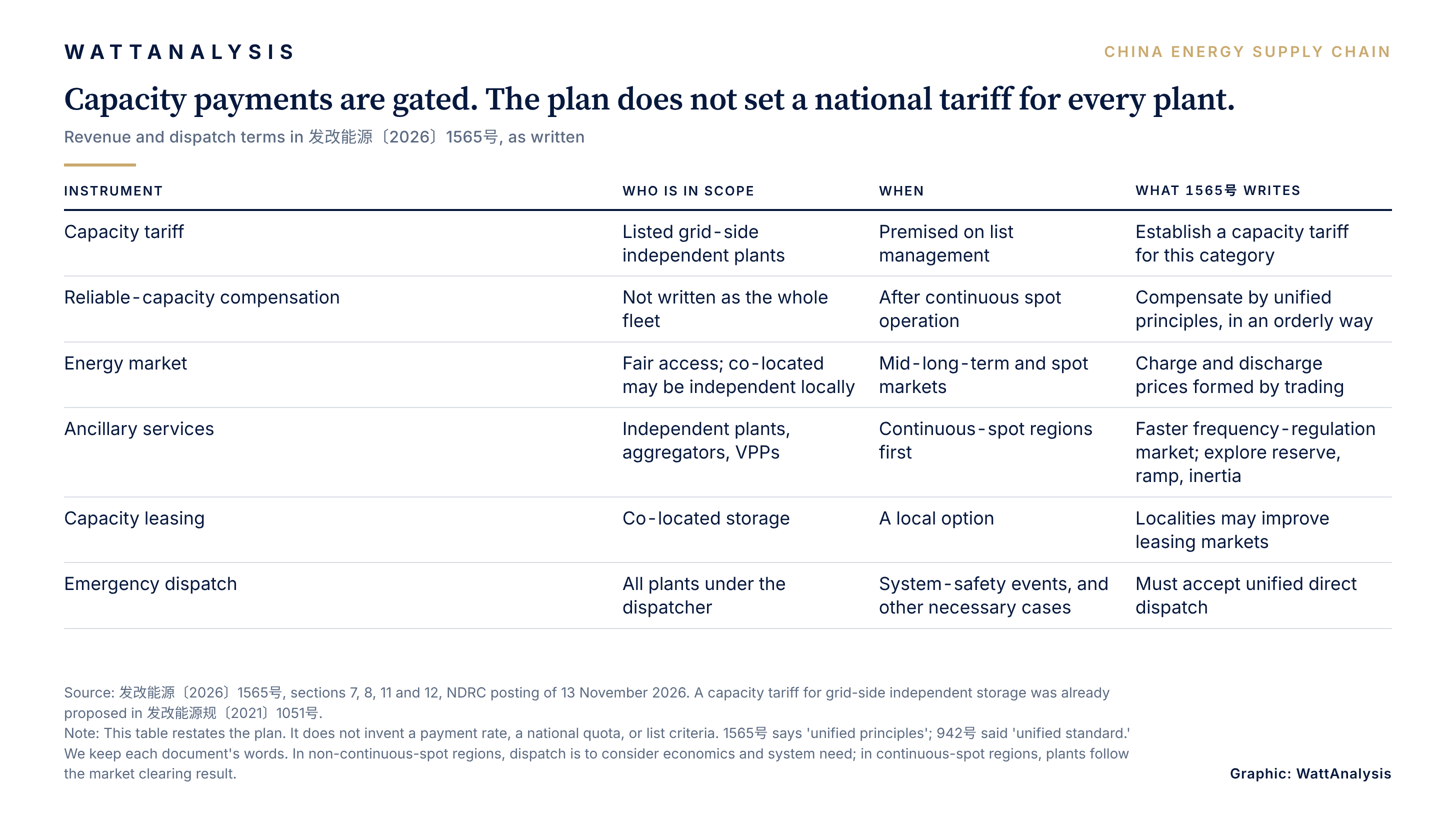
At about 3 hours, 300 GW implies 900 GWh, our calculation, not an official energy target. The plan makes a storage capacity tariff conditional on list-based management.

300 GWNew-type storage power stock the fleet is to reach by 2030 — the headline figure, already carried in the June and August 2026 plans
≈3 hoursAverage fleet duration the plan adds — “about 3 hours” in the official text; the plan publishes no gigawatt-hour target
900 GWhImplied energy stock at an exact 3.0-hour average — our calculation, not an official energy target

The National Development and Reform Commission (NDRC, 国家发展改革委) and the National Energy Administration (NEA, 国家能源局) formally issued the Implementation Plan for New-Type Energy Storage in the 15th Five-Year Plan Period (《"十五五"新型储能实施方案》) on 29 October 2026 and posted it on their websites on 13 November 2026. The NDRC notice is numbered 发改能源〔2026〕1565号. It is a formal issuance (印发), not a comment draft. The 300 GW headline is a power figure already on the books in two earlier 2026 plans. This document adds an average duration of "about 3 hours" (3小时左右). At an exact 3.0-hour average, 300 GW would hold 900 GWh, our calculation, not an official energy target or a shipment total. The operational news is who gets paid and how plants are dispatched: a capacity tariff only for listed grid-side independent storage, and reliable-capacity compensation only after the electricity spot market is in continuous operation.

New-type energy storage (新型储能) is the official category that sits beside pumped-hydro storage (抽水蓄能), not inside it. The June 2026 energy-system plan, 发改能源〔2026〕884号, issued on 13 June and posted on 25 June, already said that by 2030 pumped hydro would reach "about 160 GW" and new-type storage would reach 300 GW. The August 2026 power-system plan, 发改能源〔2026〕942号, posted on 3 August, repeated the 300 GW figure, classified it as an indicative (预期性) indicator, and set a 15th Five-Year increment of "about 160 GW." In that plan's indicator table the 2025 starting point is 1.36 亿千瓦, the same 136 GW NEA reported at its 30 January 2026 press conference. This implementation plan, 1565号, says the national fleet is to "reach 300 GW" by 2030, and that new-type storage is to move from a scale-development stage into a market-oriented stage. It attaches no new 预期性 or 约束性 (binding) label of its own. We read 300 GW as a power stock in 2030, consistent with the earlier plans, not as a new headline.

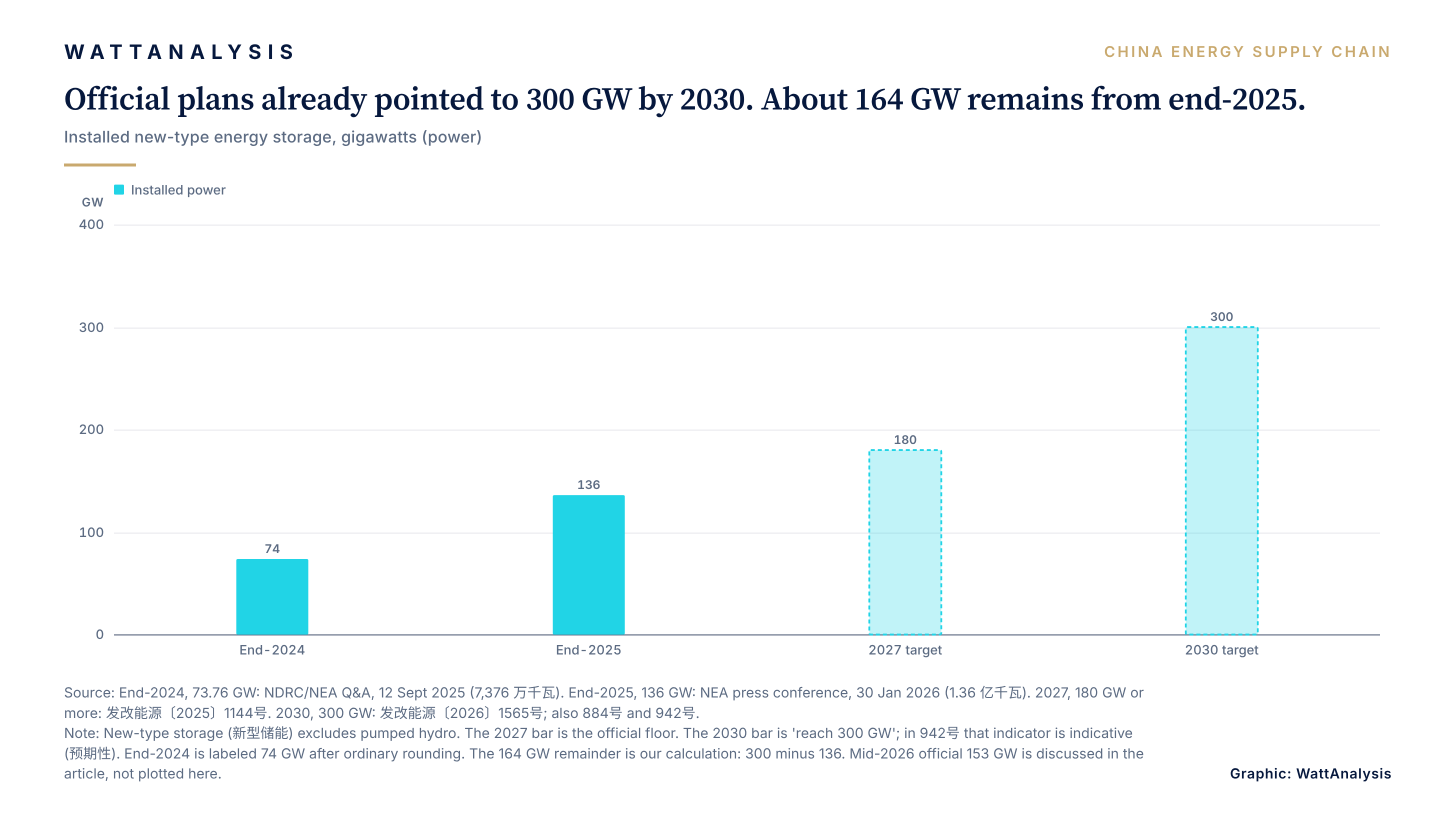
The July 2021 guiding opinion, 发改能源规〔2021〕1051号, already set a 2025 target of "30 GW or more" (3000万千瓦以上) as China moved from early commercialization toward scale. At the end of 2025, NEA reported 136 GW / 351 GWh already in operation, with an average duration of 2.58 hours, up 84% in power from the end of 2024 and "more than 40 times" the level at the end of the 13th Five-Year Plan. The end-2024 official power figure, given in the NDRC/NEA question-and-answer on the 2025 to 2027 action plan, is 7,376 万千瓦, or 73.76 GW. The 2025 addition is about 62 GW, our calculation (136 minus 73.76). The 136 GW outcome is about 4.5 times the 2021 floor of 30 GW, our calculation (136 / 30). The 14th Five-Year target was a floor that the industry went through, but that history does not, by itself, make 300 GW a floor. The 1565号 text says "reach," not "or more."

The intermediate official target is the 2025 to 2027 action plan, 发改能源〔2025〕1144号, issued on 27 August 2025 and posted on 12 September: 180 GW or more by the end of 2027, with "more than 100 GW" of additions over those three years and about 250 billion yuan (约2500亿元) of direct project investment. From 136 GW at end-2025, the 180 GW floor is at least 44 GW over two years, our calculation. As reported on the NEA website on 7 August 2026, quoting Xu Jilin (徐继林), deputy director of NEA's Energy Conservation and Technology Equipment Department, at an NEA press conference, and sourced there to People's Daily Online (人民网), installed new-type storage at the end of June 2026 was 153 GW / 396 GWh, up 61% from a year earlier. That mid-year figure comes from a media report rather than a year-end statistical bulletin. On that reported basis, about 17 GW was added in the first half of 2026, our calculation (153 minus 136), leaving about 27 GW to the 180 GW floor, our calculation, with 18 months then left to the end of 2027. From end-2025, 164 GW remains to 300 GW, our calculation (300 minus 136); from mid-2026, about 147 GW remains, our calculation (300 minus 153). If the 2030 figure is met and not exceeded, those increments are a slower annual pace than 2025. They are not a forecast of shipments or factory output. The 300 GW figure is a national operating stock of new-type storage, of more than one technology, after retirements and conversions. It is not a 2026 to 2030 sales total, and it is not a total addressable market for lithium cells.

Chart 1 — Installed new-type energy storage in gigawatts: 74 GW at end-2024, 136 GW at end-2025, the 180 GW target for 2027 and the 300 GW target for 2030

Chart 1 uses only year-end official observations and official targets. The 2027 bar is a floor (180 GW or more), drawn at 180. The 2030 bar is "reach 300 GW." The End-2024 bar is labeled 74 GW after ordinary rounding; the official figure is 73.76 GW. Mid-2026's 153 GW, discussed above, is left off the chart so the series stays with year-end documents.

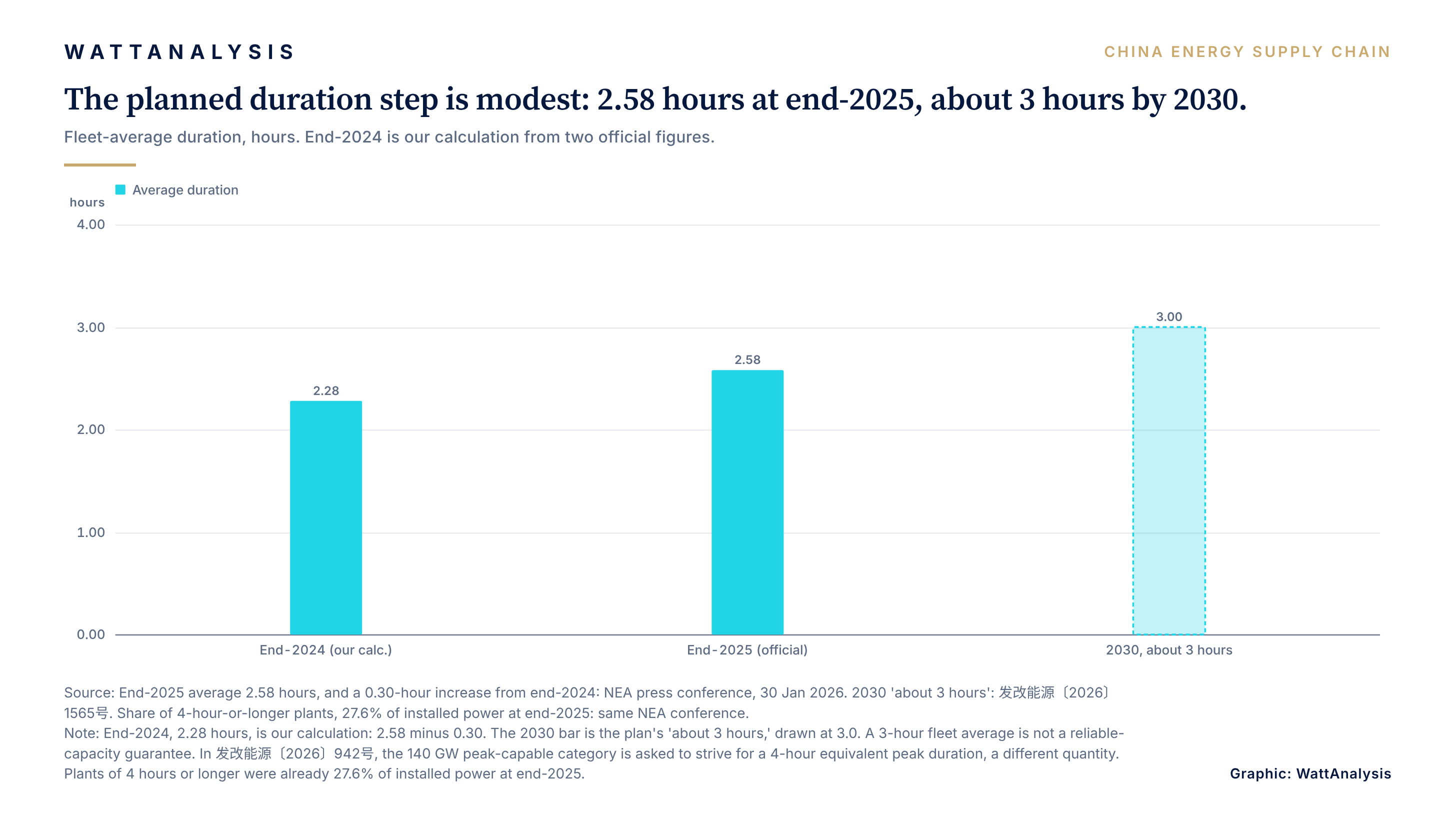
The duration clause is the one number in 1565号 that the June energy-system plan did not have. The fleet is to have an average duration of "about 3 hours." "About" is in the official text. The plan publishes no gigawatt-hour target.

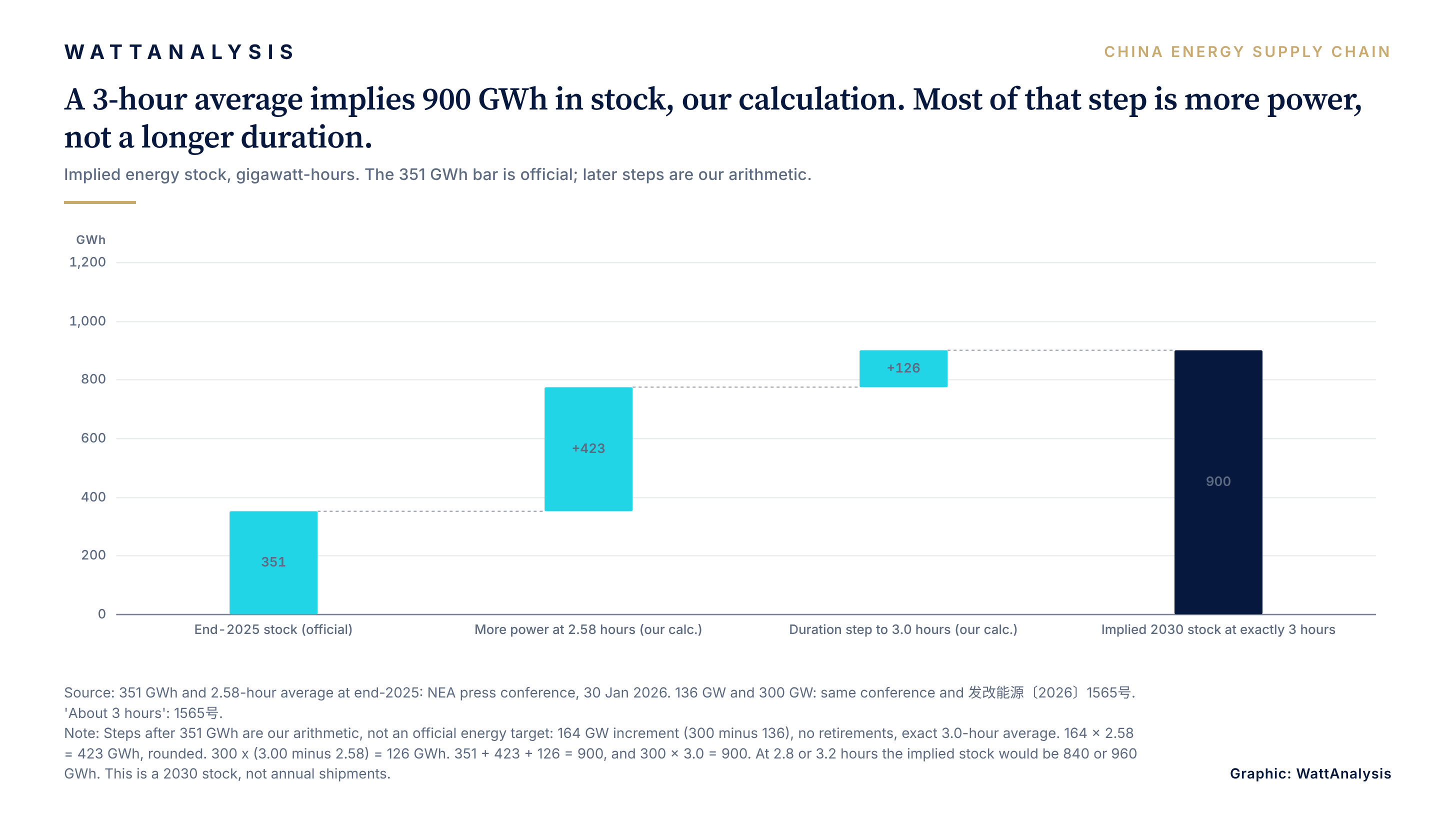
At the end of 2025, NEA's official pair was 136 GW and 351 GWh, and the stated average was 2.58 hours (351 / 136 = 2.5809, which rounds to 2.58). NEA also said that this average was 0.30 hours higher than at the end of 2024, so the end-2024 average is 2.28 hours, our calculation (2.58 minus 0.30). If the 2030 average were exactly 3.0 hours, 300 GW would hold 900 GWh, our calculation (300 × 3.0). That is an implied stock, at one exact value of a range the plan does not close. If the average were 2.8 hours, the implied stock would be 840 GWh; at 3.2 hours, 960 GWh, our calculation. The rest of this note uses 900 GWh as the exact-3-hour case, labeled as ours.

The step from 2.58 hours to 3.0 hours looks small next to the step from 136 GW to 300 GW. Starting from the official 351 GWh, a 164 GW addition at today's 2.58-hour average would add 423 GWh, our calculation (164 × 2.58 = 423.12, rounded to 423). Raising the whole 300 GW fleet from 2.58 hours to 3.0 hours adds a further 126 GWh, our calculation (300 × 0.42). 351 + 423.12 + 126 = 900.12, which is approximately 900. Most of the implied energy growth is more power. The duration step is about 23% of the 549 GWh implied increment (126 / 549), our calculation, under these assumptions: no retirements, a 164 GW addition, and an exact 3.0-hour average on the whole fleet. If existing plants stayed at 2.58 hours and only new plants brought the fleet average up, those new 164 GW would have to average 3.35 hours, our calculation ((900 minus 351) / 164 = 3.3476, rounded to 3.35). That is a sensitivity, not a plan figure. The document supports upgrades of existing plants that are in a position to be upgraded, but it does not say how much of the duration step will come from new builds and how much from retrofits.

Chart 2 — Waterfall of the implied 2030 energy stock: the official end-2025 stock of 351 GWh, plus 423 GWh from more power at 2.58 hours and 126 GWh from the duration step to 3.0 hours (both our calculation), reaching 900 GWh

Chart 2 makes that decomposition visible. The opening bar is official; everything after it is our arithmetic. This is a 2030 stock, not annual output or a market forecast.

The 3-hour figure is a fleet average, not a mandate that every project last three hours, and it is not a reliable-capacity credit. The plan says that in the 15th Five-Year period, new-type storage is mainly to meet intra-day regulation needs on the generation, grid and load sides. Cross-day and longer storage of electricity, heat and hydrogen is something the plan says should be "explored" and configured. At the end of 2025, plants of four hours or longer were already 27.6% of installed power, up about 12 percentage points from the end of 2024, according to the same NEA conference. A rising share of longer plants can lift a fleet average without every new plant being a four-hour unit, and without a three-hour nameplate being treated as four hours of accredited peak capacity.

Chart 3 — Fleet-average storage duration in hours: 2.28 at end-2024 (our calculation), 2.58 at end-2025, and about 3 hours in 2030

Chart 3 puts the duration step on the same scale as a four-hour line, which the axis reaches but the official average does not. The End-2024 bar, 2.28 hours, is our calculation from the two official figures. The 2030 bar is the plan's "about 3 hours," drawn at 3.0. Equivalent peak duration, discussed in the next section, is not the same as nameplate average duration. A single 3-hour discharge is not a guarantee of reliable capacity.

The fleet is also not all lithium, even though lithium is most of what is already built. At the end of 2025, lithium-ion accounted for 96.1% of installed new-type storage, NEA said, and compressed-air, flow-battery and flywheel storage together for the remaining 3.9%. The implementation plan tells lithium-ion to iterate and upgrade, sodium-ion to be promoted, and compressed-air, flow-battery and flywheel storage to move from pilots toward commercial use. Supercapacitors, compressed-carbon-dioxide, liquid-air, gravity and molten-salt heat storage are encouraged as pilots. Solid-state batteries, heat-pump electricity storage, thermal storage and hydrogen storage are placed in a frontier reserve. A 900 GWh implied stock, if that is what the 3-hour average produces, is therefore not a 900 GWh lithium-cell order book.

Column 2 of the implementation plan says that by 2030, "grid-side independent new-type storage that can undertake a peak-supply role" (可承担顶峰保供作用的电网侧独立新型储能) is to be "about 140 GW." The definition is grid-side, independent, and able to take on peak supply. It is not all grid-side storage, and it is not all independent storage. The same 140 GW, and the same functional wording, already appeared in the August power-system plan, 942号, which also said that during the 15th Five-Year period the country would add "about 80 GW" of this category, and that equivalent peak duration should "strive to reach 4 hours." The implementation plan does not repeat the 80 GW increment or the 4-hour equivalent, but it tells provinces to break down and implement the regional guidance scale already set in the power-system plan, together with electricity-adequacy warnings. We treat 140 GW as a functional 2030 stock that was already official in August, not as a new total, and the 4-hour equivalent peak duration remains the governing language for that category in 942号.

At the end of 2025, independent storage of all kinds, not only the peak-capable grid-side subset, was 51.2% of the national fleet, NEA said, which is about 69.6 GW, our calculation (0.512 × 136). New independent installations in 2025 were 35.43 GW (3,543 万千瓦). Those figures describe a wider set than the 140 GW category. The 80 GW increment in 942号, next to a 140 GW 2030 stock, would imply about 60 GW of this category at the start of the 15th Five-Year period, our arithmetic (140 minus 80). The plans do not themselves publish a 2025 baseline for the peak-capable subset, and that 60 GW remainder is not an official published baseline.

Column 1 says that by 2030, new-type storage "configured at new-energy bases" (新能源基地配置新型储能) is to be "about 50 to 60 GW." The column covers desert, Gobi and barren-land bases (沙戈荒), hydro-wind-solar integrated basins, and offshore wind, including deep-sea energy islands, "as needed." The named onshore bases include Gansu's Badan Jilin, Xinjiang's Taklamakan, the Songliao clean-energy base in the northeast, Inner Mongolia's desert bases, and Qinghai. The hydro-wind-solar list includes the Yalong, upper Jinsha, upper Lancang, southeastern Tibet (Yucha), upper Yellow River in Qinghai, and the middle and lower Jinsha. This 50 to 60 GW is a configuration figure at bases, not a second national total, and not a statement that every megawatt at a base is an independent market unit. The June and August plans already discussed storage at those bases; the 50 to 60 GW range is the specific band this implementation plan adds.

The plan does not add 140 GW and 50 to 60 GW. Adding them would produce 190 to 200 GW, our arithmetic, which is not 300 GW and is not a residual that "proves" a third official bucket. The two figures have different legal and functional definitions. The documents do not present them as a partition of the 300 GW. Even if "grid-side independent" and "configured at a generation base" are distinct project types, the 140 GW is itself a subset defined by a peak-supply role. The rest of the 300 GW includes co-located storage at ordinary renewable plants, storage at coal and retired thermal sites, distribution-level and user-side projects, and any grid-side plants outside the peak-capable independent category. The plan encourages those uses but gives them no separate gigawatt targets in this document.

The 140 GW is also not 140 GW of four-hour lithium. The 4-hour figure in 942号 is an equivalent peak duration to strive for, for that category. How accreditation will work, how much derating a 2-hour or 3-hour plant will take, and which plants get onto the list, are not settled in 1565号.

The payment and dispatch sections should be read as written, not as a national capacity payment for every storage plant.

A capacity tariff for grid-side independent storage is not a new idea. The 2021 guiding opinion already said China should "establish a capacity-tariff mechanism for grid-side independent storage stations." The 2025 to 2027 action plan said authorities should improve capacity tariffs for regulating resources, including new-type storage, and "in an orderly way" establish a reliable-capacity compensation. The August power-system plan, in Column 9, item 4, said the same in slightly different words: improve capacity tariffs for coal, gas, pumped hydro and new-type storage, and establish a reliable-capacity compensation "according to a unified standard," then, when conditions are ripe, explore a market mechanism and, in places that are ready, a capacity market. This implementation plan is more precise about the gate.

Section 12 of 1565号 says: "On the premise of implementing list-based management, establish a capacity-tariff mechanism for grid-side independent new-type storage. After the electricity spot market is in continuous operation, establish a reliable-capacity compensation mechanism in an orderly way, and compensate according to unified principles, so as to guide reasonable investment and efficient use." Section 7, on project management, separately says authorities should "further strengthen list management of grid-side independent new-type storage." The list (清单制) is both a management tool and the premise for the tariff. The plan publishes no list criteria, no yuan-per-kilowatt rate, no national quota of listed megawatts, and no rule that every independent plant will be listed.

The two sentences in section 12 are sequenced. A capacity tariff, for listed grid-side independent plants, is premised on the list. A reliable-capacity compensation comes "after" continuous spot-market operation, "in an orderly way," and "according to unified principles." 1565号 says "unified principles" (统一原则). 942号 said "unified standard" (统一标准). Each document's wording is kept; the two phrases are not treated here as the same legal test. The plan does not say whether the later compensation replaces the tariff, sits on top of it, or applies to a wider set of resources, and those readings are left open. It also does not say that co-located or user-side plants receive either payment. For co-located storage, the text is permissive: "localities may improve co-located storage capacity-leasing markets," so that co-located capacity value can be reasonably reflected. That is a permission, not a national mandate and not a published leasing price.

Energy-market access is written more broadly. The plan says new-type storage should participate fairly in mid- and long-term markets and in the spot market, and that charge and discharge prices should be formed through market trading. Large renewable bases that have storage may participate as a whole in interprovincial mid- and long-term markets. Where local rules allow, co-located storage may participate as an independent market entity. The plan also says price-limit ranges in mid- and long-term and spot markets should be studied and improved, so that there is "room" for storage. It does not set those limits.

Ancillary services are tied to market maturity. In regions where the spot market is already in continuous operation, a frequency-regulation market should be established more quickly, and reserve, ramping and rotational-inertia products should be studied and explored. Storage may take part as an independent station, as an aggregator, or as a virtual power plant. Compensation and cost-allocation rules for ancillary services are to be improved. The plan does not say that these products already exist everywhere, and it gives no nationwide ancillary-service revenue figure.

Dispatch follows the same split. In continuous-spot regions, new-type storage is to be operated according to the market clearing result. In regions where the spot market is not yet in continuous operation, dispatch is to consider both economics and system need. Co-located storage at a generation site may be jointly dispatched with its plant, and the plan supports that. In a system-safety incident, and in other necessary cases, every new-type storage plant under the dispatcher's jurisdiction must accept unified direct dispatch. Existing plants that can be upgraded may be upgraded, with safety first and economics in mind, so that utilization can keep rising. NEA's preliminary figure for 2025 was 1,195 equivalent utilization hours nationally, up by nearly 300 hours from 2024, with 1,175 hours in the State Grid area and 1,294 hours in the China Southern Power Grid area. Those official hours are reported as given. They are not converted into a cycle count, because the official definition of "equivalent utilization hours" for this series is not restated in the 30 January briefing at a level that would support that conversion.

Chart 4 — Table of the revenue and dispatch terms in the implementation plan: capacity tariff, reliable-capacity compensation, energy market, ancillary services, capacity leasing and emergency dispatch, with who is in scope and when each applies

Chart 4 is a restatement of 1565号, not a model of project returns. There is no official national payment rate in this document, and none is supplied here. A developer who treats "capacity tariff" as a revenue line for every megawatt of the 300 GW is reading more than the text supports. A developer who treats the list, and the "after continuous spot" condition, as the actual gates is reading what the ministries wrote. How many megawatts will be listed, in which provinces, at what rate, and from which year, will be decided in later rules and in provincial lists.

The plan is supportive of grid-forming storage (构网型储能), and it is cautious in the same sentences. Grid-forming is to be advanced "actively and steadily," with scene demand as the starting point. Reliability and the ability to support the grid are to be verified. Planning, configuration and equipment standards are to be improved gradually. The places named are where a weak or stressed grid would use that capability: large renewable clusters, sending and receiving ends of transmission corridors, cities whose load has hollowed out, weak grids and islanded grids, and, on the grid-side column, nodes with concentrated renewable connections, dense load, or large DC infeeds. The services listed are peak regulation, frequency, voltage, emergency reserve, ramping and black start. None of that is a gigawatt target, a procurement mandate, or a ranking of inverter makers. Whether grid-forming works at scale is, in the plan's own words, something to be verified.

Data centers are treated the same way. The plan "encourages reasonable configuration" of new-type storage at data centers, to help computing and electricity develop in a coordinated way. A short column on "reliable energy use at computing facilities" points to the eight national computing hubs (Beijing-Tianjin-Hebei, the Yangtze River Delta, the Greater Bay Area, Chengdu-Chongqing, Guizhou, Inner Mongolia, Gansu and Ningxia) and to computing-electricity coordination zones in Qinghai, Xinjiang and Heilongjiang. There, storage plants may be built according to local conditions, and "cluster-shared storage reserve services" may be explored, in order to raise the reliability of electricity supply and to protect data security. That is an encouragement to explore a shared-reserve model. It is not a mandated backup standard or an hours-of-autonomy rule, and it is not a gigawatt target for data-center storage.

On industry structure, the plan is direct about both lithium and discipline. Section 13 says authorities should implement lithium-battery industry regulation, guide storage-battery firms to advance projects in a reasonable and orderly way, and "guard against the risk of blind expansion." Manufacturers are encouraged to improve raw-material security and product quality, and to study a recycling system. Localities may foster industrial clusters according to local conditions, and should "strengthen market judgment and assessment," so that demand guides the industry and capacity is reasonably laid out. This is the plan's own language about orderly expansion. It is not a closure of the lithium route, and it is not a license to read a 300 GW power target, or a 900 GWh implied stock, as a five-year factory-build program.

International cooperation, green finance, policy-based financial instruments, medium- and long-term manufacturing loans, and local-government special bonds are mentioned as support for projects that meet the conditions, and private firms may take part in major science-and-technology programs and in storage investment. Those are instruments, not appropriations in this document, and no yuan total is attached to them here. The 250 billion yuan figure cited earlier belongs to the 2025 to 2027 action plan, not to this 2030 stock.

Several later documents would change how this plan should be read.

If a national or provincial implementing rule set a capacity-tariff rate, a list of eligible plants, and a published list size, the payment section would move from a gate to a number. If listed capacity were a small share of the 140 GW peak-capable category, or of the 300 GW national stock, the tariff would remain a narrow instrument. If it were most of the independent fleet, the opposite would be true. That number is not yet public.

If official rules defined how reliable capacity is accredited, including any derating for plants shorter than four hours, the gap between a 3-hour nameplate average and a 4-hour equivalent peak duration would become a calculable credit, not only a warning. If a later document published a gigawatt-hour target, we would compare it with our 900 GWh calculation rather than treat that calculation as the official goal.

If NEA's next official year-end figures showed the fleet average already near 3 hours, or showed a sharp change in the 4-hour-or-longer share, the "modest duration step" reading would need to be updated. If the 300 GW indicative figure were revised, or restated as a floor or a cap, the gap from 136 GW (or from 153 GW at mid-2026, as reported) would change. If the mid-2026 153 GW / 396 GWh pair is restated, or not confirmed, in a later statistical release, we would drop or replace that mid-year point.

We would also change the payment discussion if continuous spot-market operation were declared, or withdrawn, in a large set of provinces, because that is the official condition for the reliable-capacity compensation. And we would change the technology discussion if official installed-capacity data showed lithium's 96.1% share moving in a way the plan's "iterate lithium, promote sodium, commercialize compressed-air and flow" ladder does not describe.

What would not, by itself, change the reading is a news-cycle claim that "China has set a 900 GWh target" or that "every storage plant will receive a capacity tariff." Neither sentence is in the official text.

Primary sources

Implementation plan, 发改能源〔2026〕1565号.

Joint notice of NDRC and NEA, formally issued (印发) on 29 October 2026 and posted on the websites on 13 November 2026. The NDRC PDF is the 14-page plan body; the document number and the 29 October date sit on the HTML notice. The NEA notice (index 000019705/2026-000183) carries the same issuance date, with a PDF.

Energy-system plan, 发改能源〔2026〕884号.

Issued 13 June 2026, posted 25 June 2026. 2030 new-type storage "reaches 300 GW"; pumped hydro "about 160 GW."

Power-system plan, 发改能源〔2026〕942号.

Posted 3 August 2026. 300 GW as an indicative (预期性) indicator, with a 2025 value of 1.36 亿千瓦; 15th Five-Year increment "about 160 GW"; peak-capable grid-side independent storage, about 80 GW of additions in the period and 140 GW by 2030, equivalent peak duration to "strive to reach 4 hours"; Column 9, item 4, on capacity tariffs and reliable-capacity compensation "according to a unified standard."

2025 to 2027 action plan, 发改能源〔2025〕1144号.

Issued 27 August 2025, posted 12 September 2025. 180 GW or more by end-2027; more than 100 GW of additions in three years; about 250 billion yuan of direct project investment; capacity-tariff and reliable-capacity language. The NDRC/NEA Q&A of 12 September 2025 gives end-2024 installed capacity of 7,376 万千瓦 (73.76 GW).

2021 guiding opinion, 发改能源规〔2021〕1051号.

Posted 23 July 2021. 2025 target of 30 GW or more; 2030 "comprehensive market-oriented development"; already calls for a capacity tariff for grid-side independent storage stations.

NEA press conference, 30 January 2026.

Bian Guangqi (边广琦), deputy director, Energy Conservation and Technology Equipment Department. End-2025: 136 GW / 351 GWh, average 2.58 hours, up 0.30 hours from end-2024, up 84% in power; "more than 40 times" the end of the 13th Five-Year Plan; 72% of capacity in plants of 100 MW or more; 27.6% in plants of 4 hours or longer; independent storage 51.2% of the fleet, 35.43 GW of independent additions in 2025; lithium-ion 96.1%, other routes 3.9%; equivalent utilization 1,195 hours, up nearly 300 hours, State Grid 1,175 and China Southern 1,294.

Mid-2026 installed capacity, as reported.

NEA website, 7 August 2026, sourced to People's Daily Online, quoting Xu Jilin at an NEA press conference: 153 GW / 396 GWh at the end of June 2026, up 61% year on year. Used with that attribution.

Every number in the body is either a figure from a named official notice, plan, or NEA press conference, or arithmetic on those figures, labeled "our calculation" or "our arithmetic." The 900 GWh stock, the 164 GW and 147 GW remainders, the 423 GWh and 126 GWh waterfall steps, the approximately-900 reconciliation (351 + 423.12 + 126 = 900.12), the 2.28-hour end-2024 average, the 3.35-hour implied duration of new builds, the 4.5-times comparison with the 2021 floor, the 69.6 GW independent fleet, and the 840 and 960 GWh sensitivities are all of that second kind. They are not market estimates and not official energy targets.

Briefing figures that appear in some 13 November media reports but not in the 1565号 text, including a 110 GW incremental "provincial self-use" figure, a 240 GW provincial self-use stock, and a description of 300 GW as a "floor," are not used here. Industry-association installed-capacity totals, which use a different methodology from NEA's official series, are also not used.

The mid-2026 153 GW / 396 GWh pair is official in the limited sense that it is reported on the NEA website, quoting an NEA official, but it is a media-sourced page rather than a statistical bulletin or a posted transcript. It is used in the prose, attributed, and left off Chart 1.

"New-type energy storage" throughout excludes pumped hydro, as it does in the official documents. Power is in GW, energy in GWh, duration in hours. 1 亿千瓦 is 100 GW; 1 万千瓦 is 0.01 GW. End-2025 "1.36 亿千瓦 / 3.51 亿千瓦时" is written as 136 GW / 351 GWh, which is the official rounding we follow. Comparisons use the same official series at stated dates.

You can find more of our research at wattanalysis.com.

Full note above — free to cite with attributionREADER · FREE

Standalone page ↗

STORAGE · CELL FORMATVERIFIED

Storage
The 314Ah Standard: How One Cell Format Took Over China's Storage Industry

No ministry ever decreed it. No GB standard contains it. Yet within roughly two years, one number — 314Ah — went from a product launch to the default specification of China's stationary-storage industry, the capacity rating that cell makers build to, integrators design around and tenders increasingly assume. Our earlier short card on this page called cell format "a pricing weapon"; this note is its full expansion, rebuilt from the manufacturers' own announcements and the one policy document that frames them. It explains what 314 ampere-hours actually buys, why the winning move was to change the inside of the cell and not its shell, how a format becomes a standard without ever being standardised — and why the industry is already racing past it. Where a figure below is a manufacturer's claim rather than a measured fleet outcome, this note says so on its face.

314 AhCharge capacity of one prismatic LFP cell — at the 3.2 V nominal voltage of this cell class, ≈1.005 kWh per cell
+12.1%Energy per cell over the 280Ah generation it replaced (896 Wh → 1,004.8 Wh) — arithmetic from the two ratings at the same nominal voltage
5.0 MWhEnergy in one 20-foot cabin built on 314Ah cells — up from 3.354 MWh in the 280Ah generation, per CATL's EnerD delivery announcement

01 · THE NUMBERWhat "314Ah" actually says — and what it does not

Start with the unit, because the industry's shorthand hides it. Ah — ampere-hours, 安时 — is a measure of electric charge, not of energy. A 314Ah cell can, in rating terms, deliver 314 amperes for one hour. It becomes an energy figure only when multiplied by voltage: the prismatic lithium-iron-phosphate (磷酸铁锂, LFP) cells of this class carry a nominal voltage of 3.2 V, so one 314Ah cell stores 314 × 3.2 ≈ 1,005 Wh — just over one kilowatt-hour per cell. BatteroTech (瑞浦兰钧), which launched its 314Ah cell in May 2023, markets exactly this threshold: in its launch material the cell's selling point is "1 precise kWh" per cell.

That crossing matters commercially more than electrochemically. The predecessor generation, the 280Ah cell that defined the industry's first mass market, stores 280 × 3.2 = 896 Wh at the same nominal voltage. The step to 314Ah is therefore +12.1% energy in every cell, every module and every rack position — before any other engineering changes. System designers price storage by the kilowatt-hour; a cell that rounds to one kilowatt-hour makes every downstream calculation — cells per megawatt-hour, racks per container, containers per site — simpler and, per unit of energy, smaller.

One clarification this site's Standards guide makes necessary: 314Ah is not a standard number. Search the national standards system and you will not find a GB or GB/T document that prescribes a 314Ah cell. The governing product standard for the cell itself, GB/T 36276-2023 《电力储能用锂离子电池》 Lithium-ion battery for electrical energy storage — shelved in our Standards library — specifies performance, safety and test methods for storage cells; it does not fix their capacity rating. "The 314Ah standard" is a standard in the market sense only: a specification so widely adopted that designing against anything else became the exception. Sections 02 and 03 explain the two mechanisms that made it one.

02 · THE TRICKSame shell, more inside — the engineering move that let a format flip in one product cycle

A capacity step normally forces a redesign: new cell dimensions mean new module tooling, new rack geometry, new container layouts, new certifications. The 314Ah generation avoided all of that by holding the outside constant. CALB (中创新航) states the move in one sentence in its own product announcement: working from its L173 cell platform, it "enhanced the 280Ah core to introduce the 314Ah lithium iron phosphate batteries for energy storage" — a step it describes as achieved "without altering the size specification", and which it presents as the world's first mass production and delivery of such a cell. Higee (海基新能源) describes its 314Ah cell the same way: size-compatible with the mainstream 280Ah cells it replaces, so that system designs built for 280Ah carry over.

The system-level consequence shows up in the container, the unit the industry actually buys. When CATL (宁德时代) announced mass-production delivery of its EnerD series in August 2023, the headline was a cell — "a new generation of 314Ah cells for energy storage" (新一代314Ah储能专用电芯) — and the measurable result was at cabin level: paired with CATL's CTP liquid-cooling 3.0 grouping technology, the same 20-foot cabin went from 3.354 MWh to 5.0 MWh. CALB's own 20-foot liquid-cooled product built on its 314Ah cell is rated 5.016 MWh, which CALB presents as a 34% increase in volume energy density over its predecessor system. Two different manufacturers, two different system designs, one shared threshold: 5 MWh in a 20-foot box became the new reference size of a Chinese storage block, and 314Ah is the cell arithmetic that gets you there without enlarging the box.

Fewer, larger cells also means fewer of everything else per megawatt-hour: fewer cells to weld, fewer connections to monitor, fewer BMS channels, fewer potential failure points to warranty. That is the whole economic argument of the format — not a chemistry breakthrough, but a parts-count reduction delivered inside an unchanged envelope, which is precisely why integrators could adopt it at the speed they did.

03 · THE MECHANISMHow a format becomes a standard when no standard exists

If no document mandates 314Ah, why did everyone converge on the same number — not 300, not 320? The primary sources show three reinforcing mechanisms, and one honest exception that proves the rule.

  • The anchor tenants moved first, in the same season. CATL's EnerD delivery (August 2023) and CALB's mass-produced 314Ah both date to 2023; BatteroTech launched its 314Ah cell in May 2023; EVE Energy (亿纬锂能) built its commercial-and-industrial cabinets on its MB31 cell alongside the older LF280K. When the largest cell makers ship the same rating in the same year, integrators' next designs follow the available supply — and each new 314Ah-based container, cabinet and tender makes the rating more available still.
  • By early 2024 the makers themselves were calling it the industry default. When EVE launched its 628Ah "Mr. Big" cell in January 2024, its own comparison baseline was "the 314Ah scheme commonly adopted across the industry" (行业普遍采用的314Ah方案) — the larger cell's pitch was that it halves cell count, connection points and system parts relative to 314Ah. A format that a competitor uses as the benchmark in its own launch material has already won the argument this section is describing.
  • Policy framed the manufacturing race without picking the size. The eight-department 《新型储能制造业高质量发展行动方案》 Action Plan for the High-Quality Development of the New-Type Energy Storage Manufacturing Industry (MIIT & seven agencies, Feb 2025, 工信部联电子〔2025〕7号) — the document our earlier short card anchored to — pushes the sector toward high-end, intelligent and green manufacturing, toward cultivating 3–5 ecosystem-leading enterprises by 2027, and, in its lithium-battery column, toward "large-capacity, high-safety storage batteries" (大容量高安全储能电池). It names no cell capacity. The state's role in the 314Ah story is industrial-policy weather, not specification: convergence was an engineering and procurement outcome, reached inside a policy environment that rewards scale and cost-down. Readers who meet a claim that "Beijing mandated 314Ah" should ask for the document; there isn't one.
  • The exception: convergence was never total. REPT BatteroTech also sells a 320Ah cell (its "Wending" 问顶 series), and other makers fielded 300Ah-plus ratings that are not 314. The market did not standardise on one drawing — terminal positions, height and cycle-life ratings differ by maker — it standardised on one capacity class. Section 05 returns to what that distinction costs buyers who miss it.

04 · THE PRICEWhat the format does to $/kWh — with the claims labelled as claims

The format's commercial effect runs through parts count, and the manufacturers' own numbers let a reader size it — provided each number keeps its attribution. CALB states that its 314Ah-based 20-foot system cuts the cost per kWh by over 15% against its predecessor, raises usable electricity by 5% through thermal management, and extends system life to over 12,000 cycles. EVE rates the C&I cabinets built on its LF280K and MB31 cells at 8,000 effective cycles and 94% energy efficiency. These are manufacturer figures, published in launch and exhibition material under each maker's own test conditions; they are evidence of the direction and rough size of the format's advantage, not fleet-measured outcomes, and this note cites them as claims, not measurements.

A public list-price snapshot points the same way. On CATL's own B2B storefront, the listed starting prices reported in September 2026 were 0.403 yuan/Wh for the 314Ah cell against 0.470 yuan/Wh for the 280Ah (1P) cell — the newer format listed cheaper per watt-hour than the one it replaced, on the same shopfront, in the same week. Two cautions, in this site's usual form: these are list prices for small-lot direct sales, not tender prices, and the storefront adjusts them (both had moved within the same month). What the snapshot establishes is narrower and still useful: by 2026 the 314Ah cell was no longer a premium novelty commanding a novelty price.

What this note deliberately does not give is a single market price for a 314Ah cell or a 314Ah-based system. Tender prices in China are project-specific, mostly undisclosed, and move with lithium carbonate and with the brutal capacity competition our Data section documents in adjacent segments; a $/kWh figure quoted without its tender, date and scope would fail the same check this note applies to everyone else's numbers. The defensible statement is the mechanism: same box, ≈12% more energy per cell position, fewer parts per megawatt-hour — and therefore a lower system cost floor for every integrator building on the format, in China or, via exported containers and cabinets, in North America and Europe.

05 · WHAT IT MEANSFor buyers, integrators and compliance teams outside China

  • Specify the cell, not just the chemistry. "LFP container, 5 MWh" no longer identifies what is inside. Two 5 MWh cabins can be built on different capacity classes with different parts counts, degradation behaviour and spare-parts futures. Procurement documents should name the cell model and rating (for example, a maker's 314Ah model such as EVE's MB31), the standard it is tested to — GB/T 36276-2023 in China; IEC 62619 and UL 1973 / UL 9540A in the library's North-American and international columns — and the cycle-life figure's test conditions (temperature, depth of discharge, C-rate, end-of-life capacity threshold). A cycle-life number without its conditions is marketing, per section 04.
  • "Same size" is a per-maker claim — verify it on the datasheet. CALB's no-size-change statement covers CALB's platform; it is not an industry-wide dimensional standard, because there isn't one (section 01). A 314Ah cell from a second source is not automatically a drop-in replacement for the first source's cell in the same rack: check the drawing, the terminal geometry and the swell allowance before assuming second-sourcing is free. The capacity class converged; the mechanical interface only nearly did.
  • Do not mix generations in one string. A 280Ah and a 314Ah cell in the same series string force the whole string to the smaller cell's capacity and age unevenly; in parallel arrangements the mismatch moves to balancing and warranty. Retrofit and augmentation projects should treat the capacity class as a boundary: augment within a class, or replace across it.
  • Watch the spare-parts horizon. A format this dominant is safe to buy today — every major maker ships it, and the installed base guarantees a service market. The risk is at the other end of a 15-to-20-year asset life, and section 06 is about why that risk is not hypothetical.

06 · THE SUCCESSORThe race past 314Ah has already started — read the dominance as a window, not a settlement

The same logic that created 314Ah — more ampere-hours per unchanged system position — does not stop at 314. EVE's 628Ah Mr. Big, launched in January 2024 with a 5 MWh "Mr. Giant" system, was explicitly pitched as halving the parts count of the 314Ah scheme. At the June 2025 SNEC exhibition, CATL presented its 587Ah cell as the next, third generation — describing the succession, in its own framing, as first-generation 280Ah, second-generation 314Ah now in mainstream iteration, and a transition from 314Ah toward the third generation already under way. Other makers have answered in the same 500Ah-plus class. None of this disproves the 314Ah convergence; it dates it. The 280Ah generation held the market for roughly one product cycle before the same-shell trick displaced it, and the successor cells now competing to displace 314Ah use the same argument — fewer, larger cells — at larger formats that will need new pack and container designs rather than an unchanged shell.

For a buyer signing in 2026, the practical reading is: 314Ah is the liquid, second-sourceable, price-transparent choice now, and the format against which any 500Ah-plus offer should be priced — its parts-count and $/kWh claims only mean something relative to the 314Ah baseline the industry has already absorbed. For an investor, the tell to watch is tender language: when Chinese tenders and overseas framework agreements start naming 587Ah-class cells the way they came to assume 314Ah, the window this note describes will be closing, on roughly the same two-to-three-year clock as the last one.

The answer, in one paragraph

314Ah became China's storage "standard" without any standard: an LFP cell rating of 314 ampere-hours (≈1.005 kWh at 3.2 V nominal, +12.1% over the 280Ah generation) that makers achieved inside the predecessor's size envelope, lifting a 20-foot cabin from 3.354 MWh to the 5 MWh class, cutting parts per megawatt-hour, and — once CATL, CALB, EVE and BatteroTech all shipped it in 2023 — hardening into the industry's default capacity class by procurement gravity alone.

Primary sources

CALB product announcement — 314Ah mass-produced energy-storage products (All-Energy, Melbourne)

中创新航 CALB (official company announcement, en.calb-tech.com) · the 280Ah→314Ah step "without altering the size specification", presented as the world's first mass production and delivery of the format; 20 ft liquid-cooled 5.016 MWh system, +34% volume energy density, kWh cost −15%+, system life over 12,000 cycles — manufacturer claims, cited as such in section 04

宁德时代 EnerD 系列 5MWh 液冷储能预制舱量产交付公告

宁德时代 CATL (company announcement) · Aug 2023 · EnerD series mass-production delivery built on CATL's new-generation 314Ah storage cells (新一代314Ah储能专用电芯); 20 ft single-cabin energy raised from 3.354 MWh to 5.0 MWh with CTP liquid-cooling 3.0 grouping technology

EVE Energy at SNEC ES+ 2024 — full-scenario storage products (official exhibition release)

亿纬锂能 EVE Energy (evebattery.com) · Sep 2024 · C&I cabinets built on LF280K and MB31 cells rated at 8,000 effective cycles and 94% energy efficiency — manufacturer ratings, cited as such in section 04

亿纬锂能 Mr. Big 628Ah 大电芯 / Mr. Giant 5MWh 系统发布(2024年1月)

亿纬锂能 EVE Energy (company launch, Jan 2024) · the 628Ah launch whose own baseline is "the 314Ah scheme commonly adopted across the industry" (行业普遍采用的314Ah方案), against which it claims cell count, connection points and system parts each reduced by 50%

BatteroTech 314Ah long-life storage cell launch (May 2023)

瑞浦兰钧 BatteroTech (company launch material, via PR Newswire, Jan 2024) · 314Ah cell launched May 2023 after its 280Ah and 306Ah cells, marketed on the "1 precise kWh" per-cell threshold

《新型储能制造业高质量发展行动方案》(工信部联电子〔2025〕7号)

工业和信息化部等八部门 (MIIT & seven agencies) · Feb 2025 · checked against the official MIIT text · the manufacturing action plan framing section 03: by 2027, cultivate 3–5 ecosystem-leading enterprises and achieve high-end, intelligent, green development; its lithium column prioritises large-capacity, high-safety storage batteries — it names no cell capacity rating

GB/T 36276-2023《电力储能用锂离子电池》

As shelved in this site's Standards library (#standards) · the product standard governing storage lithium-ion cells' performance and safety requirements and test methods — it prescribes no capacity rating, which is the point of section 01

Full note above — free to cite with attributionREADER · FREE

Standalone page ↗

AI × POWER · PRIMARY SOURCESVERIFIED

GridEnd UseCross-chain
China's AI Power Crunch, in Primary Sources

Ask how China will power its AI build-out and most English-language answers start with chips. The Chinese policy documents start somewhere else: with where the load is allowed to sit, what efficiency it must prove, and how much of its electricity must be green. That was the conclusion of our earlier short card on this page — datacenter load is a grid problem now, not a chip problem — and this note is its full expansion, rebuilt entirely from the primary texts: the 东数西算 "East Data, West Computing" layout plans, the 2024 data-centre green action plan, and the new-power-system plan that carries the transmission half of the answer. Interconnection queues, transformer lead times and behind-the-meter generation decide where the next gigawatt of AI capacity can land in any country; in China, those constraints are not just market facts — they are written into approval rules a foreign reader can check. Every number below is either one of the six verified NEA figures in our Data section or a target quoted from an official document named in the sources, with its Chinese title, issuing bodies and date. Where a figure in wide circulation could not be traced to a primary text, this note says so and leaves it out.

8 + 10National computing hubs and data-centre clusters fixed by the layout — four hubs in the east, four in the energy-rich west
≤1.2 PUECeiling on power usage effectiveness for data-centre projects inside national hub nodes, end-2025 target in the 2024 green action plan
>80% green electricity share required of newly built data centres in national hub nodes by end-2025 — set in the Dec 2023 opinion, repeated in the Jul 2024 plan

01 · THE QUESTIONTwo mismatches, and the two moves that answer them

China's computing demand is concentrated where its people and industry are — the east. Its cheapest, cleanest generation increasingly sits in the west and north: the wind and solar bases behind the verified end-2025 totals in our Data section (1,200 GW of solar and 640 GW of wind installed, within a 3,890 GW national system). AI training and inference widen that geographic gap every year, because a single large cluster is a power-plant-scale load that cannot be served by wishing local capacity into existence.

Beijing's documents answer with two moves run in parallel. Move the compute to the power: steer new data-centre capacity toward western hubs where renewable energy, land and cool climates are abundant — the 东数西算 programme, literally "eastern data, western computing". Move the power to the compute: keep building the west-to-east transmission arteries — 特高压 UHV (ultra-high voltage) lines under the 西电东送 west-to-east power transmission programme — so eastern load centres, including the data centres that must stay east for latency, can draw on western generation. Everything else in this note — the hub map, the PUE ceilings, the green-electricity quota — is machinery for making those two moves happen in the right order.

02 · THE LAYOUT东数西算: eight hubs, ten clusters, a written division of labour

The framework document is the May 2021 implementation plan for computing hubs in the national integrated big-data-centre system (《全国一体化大数据中心协同创新体系算力枢纽实施方案》, NDRC and partner agencies). In February 2022 the NDRC, the Cyberspace Administration, the MIIT and the NEA jointly approved the build-out, and the layout has been fixed since: eight national computing hubs — Beijing–Tianjin–Hebei 京津冀, the Yangtze River Delta 长三角, the Greater Bay Area 粤港澳大湾区 and Chengdu–Chongqing 成渝 in the east; Inner Mongolia 内蒙古, Guizhou 贵州, Gansu 甘肃 and Ningxia 宁夏 in the west — containing ten national data-centre clusters where large facilities are meant to concentrate.

The 2021 plan sorts the country by function, and the sorting is the policy. The four eastern hubs, where user scale and application demand are strongest, are to deploy capacity intensively under tight land, energy and water constraints, close to the demand they serve. The four western hubs are designated rich in renewable energy and suited by climate; their assigned role is to take the work that does not need to be near the user — background processing, offline analysis, storage and backup — as a national non-real-time computing base. Latency-sensitive work (the plan's own examples run to finance, industrial internet and AI inference serving eastern users) stays east; latency-tolerant training, rendering and archiving is pushed west. Read the hub map as a latency budget written into geography.

Later documents put numbers on the steering. The December 2023 opinion on deepening the programme (《关于深入实施"东数西算"工程加快构建全国一体化算力网的实施意见》, 发改数据〔2023〕1779号, NDRC with four partner agencies) targets, by end-2025: hub-node regions accounting for more than 60% of all new computing capacity added nationally, hub utilisation clearly above the national average, and — the figure section 04 returns to — a green-electricity share above 80% for newly built hub-node data centres. The July 2024 green action plan then hardens the layout from guidance into gatekeeping: new large and super-large data centres should be sited as a priority inside the hub clusters; large wind and solar bases are to be planned in coordination with the hubs; non-real-time facilities are supported in migrating west; and a city whose data centres older than a year sit at an overall rack utilisation below 50% may in principle plan no new clusters and no new large or super-large projects at all. Siting in China is therefore not a pure real-estate decision: the national layout is a condition of approval.

03 · THE WIRE特高压 UHV and 西电东送: the power moves east so some compute can stay

Not every workload can go west, so the second move is electrical. 西电东送 west-to-east power transmission is the decades-old programme that carries western hydro, wind and solar to eastern load centres, and its long-distance arteries are 特高压 UHV lines — the ±800 kV-and-above DC and 1,000 kV AC corridors that move bulk power across provinces with losses low enough to make the arbitrage work. The document our earlier card anchored to, the 《加快构建新型电力系统行动方案(2024—2027年)》 Action Plan for Accelerating the Construction of a New-Type Power System (NDRC · NEA · National Data Administration, Aug 2024), makes this one of its nine campaigns: a dedicated push on 大规模高比例新能源外送 large-scale, high-share renewable-energy outbound delivery — in plain terms, more and better-used corridors out of the western renewable bases, alongside the grid-stability and distribution campaigns a data-centre developer ultimately depends on.

For a reader siting load, the practical meaning is that "east versus west" is not binary. A latency-bound facility in an eastern hub is still, in the plan's logic, a claim on western electrons delivered by UHV; a training facility in a western hub is a claim on the same electrons consumed before they travel. The 2024 data-centre plan names the intended end-state 算力电力双向协同 two-way computing–electricity coordination: compute planned with the grid, and the grid planned with compute, with a first working mechanism targeted for end-2025. One honesty note, in this site's usual form: corridor-by-corridor UHV capacity figures and west-to-east transfer totals circulate widely in English coverage, but we have not yet reconciled them line by line with a primary NEA or NDRC release text, so this note cites no UHV capacity number — that point stands as 待核实 not yet verified, and the qualitative account above rests only on the documents listed below.

04 · THE RULESPUE ceilings and the 80% green rule, in the documents' own numbers

Efficiency first. 电能利用效率 — PUE, total facility energy divided by IT energy — is the metric Chinese approvals actually use, and the July 2024 《数据中心绿色低碳发展专项行动计划》 Special Action Plan for the Green and Low-Carbon Development of Data Centres (发改环资〔2024〕970号; NDRC, MIIT, NEA and the National Data Administration) states its end-2025 targets without ambiguity:

  • National average PUE below 1.5 by end-2025, with overall rack utilisation of at least 60% and renewable-energy utilisation rising an average of 10% per year.
  • New and expanded large and super-large data centres: PUE at or below 1.25 by end-2025 — and data-centre projects inside national hub nodes: PUE no higher than 1.2. The earlier four-agency plan of December 2021 (发改高技〔2021〕1742号) had set the corresponding bar at below 1.3 nationally and below 1.25 at hub nodes; the 2024 plan is a tightening, not a restatement, and project teams quoting the 2021 numbers are working from a superseded ladder.
  • Servers are specified, not just buildings. New and expanded projects must use servers meeting the efficiency levels of GB 43630-2023 (the server energy-efficiency limits and grades standard) or better — a point equipment vendors should read together with our Standards guide.

Green electricity second. 绿电 green electricity in these documents means renewable power procured and accounted as such — through green power trading 绿电交易 and green certificates 绿证, the official proof of renewable consumption — rather than a claim about the average grid mix at the socket. The rule, stated in the December 2023 opinion and repeated in the July 2024 plan, is that newly built data centres in national hub nodes exceed 80% green electricity by end-2025, inside the computing–electricity coordination mechanism above. The 2024 plan also writes the procurement into the approval itself: a new or expanded project's renewable-energy utilisation target and plan are a required, substantive part of its 节能审查 energy-saving review; projects are encouraged to raise their renewable share year by year, to co-locate with renewable generation where firm supporting power and flexibility allow, to buy through green power and certificate trading, and — in pilot form — to take 绿电直供 direct green power supply. For intelligent-computing centres inside the national AI layout, the same plan instructs regions to expedite energy reviews and strengthen green power supply guarantees: speed and green sourcing are granted together, or not at all.

One figure this note deliberately does not give: a national total for data-centre electricity consumption. Totals attributed to official agencies circulate in press coverage, but we have not traced one to a primary statistical release we can quote line by line, so under this site's discipline it stays on the withheld list — 待核实 — rather than in the text. The targets above are policy settings from named documents, not measurements; do not cite them as outcomes.

05 · WHAT IT MEANSFor operators, buyers and vendors reading from outside China

  • Siting — read the hub map before the land market. The first questions for any new large facility are now administrative: Is the site inside a national hub cluster? What is the host city's rack utilisation (below 50% on year-old stock can freeze new large projects)? Can the project pass an energy-saving review whose required contents include a renewable plan? Western hubs offer the renewable endowment the rules reward; eastern hubs offer latency the rules protect. A site outside the hub system starts the approval conversation at a disadvantage the documents make explicit.
  • Green procurement — the 80% is a new-build hub rule, met by instruments. For a new hub-node facility, plan from day one for how the >80% green share will be evidenced: green power trading contracts, retired green certificates, co-located renewables or a direct-supply pilot. The obligation attaches to the project's reviewed plan, not to a marketing claim after energisation — procurement teams should expect the energy review file, not the ESG report, to be where compliance is judged.
  • Equipment — PUE ceilings are a technology pull. A 1.2 ceiling at hub projects cannot be met by legacy air-cooled design at scale; the 2024 plan's own technology list points where demand goes: liquid cooling 液冷 and evaporative cooling, heat-pipe and fluoropump systems, DC power distribution 直流供电, modular power and high-efficiency transformers, and servers at or above the GB 43630-2023 efficiency grades. Vendors selling into Chinese AI campuses are selling against a written efficiency ladder — bring test data against the named standards, not brochure PUE.
  • Investors — separate targets, measurements and marketing. The documents above set targets (PUE ladders, the 80% rule, the 60% hub share of new capacity). Whether outcomes matched them is a different question, answerable only from the agencies' statistical releases — the same discipline our Data section applies to the NEA's six verified end-2025 figures. A pitch that quotes the 80% target as an achieved fleet average has failed the first check this note exists to teach.

The answer, in one paragraph

China powers its AI build-out by steering new data centres into eight national computing hubs — western hubs take latency-tolerant load beside abundant renewables, eastern hubs keep latency-sensitive load supplied over UHV west-to-east corridors — and by conditioning approval on efficiency and sourcing: PUE no higher than 1.2 for hub-node projects and a green-electricity share above 80% for newly built hub-node data centres by end-2025 (发改环资〔2024〕970号; 发改数据〔2023〕1779号).

Primary sources

《数据中心绿色低碳发展专项行动计划》(发改环资〔2024〕970号)

国家发展改革委 · 工业和信息化部 · 国家能源局 · 国家数据局 (NDRC · MIIT · NEA · National Data Administration) · Jul 2024 · source of the end-2025 targets quoted in this note: national average PUE below 1.5, new large / super-large PUE ≤1.25, hub-node projects ≤1.2, rack utilisation ≥60%, renewable utilisation +10%/yr, hub regions ≥60% of national new computing additions, and green electricity above 80% for newly built hub-node data centres · full text (PDF) checked line by line for this note

《关于深入实施"东数西算"工程加快构建全国一体化算力网的实施意见》(发改数据〔2023〕1779号)

国家发展改革委等五部门 (NDRC & four partner agencies) · Dec 2023 · sets the end-2025 hub targets the 2024 plan repeats: hub regions above 60% of national new computing additions, computing–electricity coordination mechanism, green electricity above 80% for newly built hub-node data centres

《全国一体化大数据中心协同创新体系算力枢纽实施方案》(发改高技〔2021〕709号)及 2022 年 2 月枢纽批复

国家发展改革委等部门 (NDRC & partner agencies) · May 2021; approvals Feb 2022 with 中央网信办 · 工业和信息化部 · 国家能源局 (CAC · MIIT · NEA) · the eight-hub / ten-cluster layout and the east–west division of labour: eastern hubs deploy intensively near demand; Inner Mongolia, Guizhou, Gansu and Ningxia take non-real-time load on renewable endowment

《加快构建新型电力系统行动方案(2024—2027年)》

国家发展改革委 · 国家能源局 · 国家数据局 (NDRC · NEA · NDA) · Aug 2024 · checked against the official release · the new-power-system frame — including the large-scale renewable outbound-delivery campaign behind the UHV west-to-east corridors; also the primary source of this page's earlier short card on datacenter load, whose conclusion this note retains

《贯彻落实碳达峰碳中和目标要求推动数据中心和5G等新型基础设施绿色高质量发展实施方案》(发改高技〔2021〕1742号)

国家发展改革委等四部门 (NDRC & three partner agencies) · Dec 2021 · the earlier PUE ladder — new large / super-large below 1.3, hub nodes below 1.25 by 2025 — against which the 2024 plan's tightening is measured

本站 Data 区六个已核实数字

WattAnalysis Verified Data section (this page, #data) · 国家能源局《2025年全国电力工业统计数据》 (NEA, Jan 2026): total installed capacity 3,890 GW, solar 1,200 GW, wind 640 GW at end-2025 — the generation base the western hubs draw on. Not cited in this note, pending primary-text verification: a national data-centre electricity-consumption total, and corridor-level UHV / west-to-east transfer capacities

Full note above — free to cite with attributionREADER · FREE

Standalone page ↗

STANDARDS · SYSTEM GUIDEVERIFIED

Cross-chain
GB, GB/T, and the Fine Print: When Is a Chinese Standard Actually Mandatory?

Every standard in our library below carries a Chinese code, and overseas readers misread those codes in two opposite ways. The first assumes any code beginning GB is a law: "Chinese national standard" sounds compulsory, so GB/T gets filed as mandatory. The second notices the /T — 推荐 recommended — and files the same document as optional, safe to ignore. Both readings are wrong. The prefix tells you only how a standard was born, not how hard it bites. What decides that is who cites it: a regulation, a grid code, a design review, a tender specification or a certification scheme can turn a "recommended" GB/T into a condition of doing business — while an uncited GB/T remains genuinely voluntary. This note is the reading guide for the whole library: the ladder of Chinese standard types, the mechanism that hardens soft standards, how to decode a standard number, and a four-step check you can run on any code you meet. Every worked example is an entry already shelved in our Standards library — no new standard numbers are introduced.

GB — mandatory national standard: compliance is a legal duty, not a choice
GB/T — recommended national standard: voluntary on its face, binding when cited
GB/Z — guidance technical document: reference material, never a requirement

01 · THE TWO MISREADINGSWhy the prefix alone cannot tell you

The "GB means law" error overstates roughly half the library. Most entries shelved below are GB/T: drafted through the national system, published by the national authority — and formally 推荐性 recommended, meaning the state encourages adoption but does not, by the document itself, compel it. Treating every GB/T as a legal duty leads compliance teams to gold-plate voluntary specifications and, worse, to stop asking the only question that matters: which instrument makes this one binding here?

The "/T means ignorable" error is the expensive one. A recommended standard that a grid operator's connection rules, a ministry's design review or a buyer's tender names as the acceptance basis is, for that project, as binding as any statute — miss it and the plant does not connect, the design does not pass review, the bid is non-responsive. The two errors share one root: reading the code as a verdict instead of as a starting point for a citation search.

02 · THE LADDERFive levels of standard, and the law that sorts them

The legal anchor is the 《中华人民共和国标准化法》 Standardization Law of the People's Republic of China (2017 revision), which fixes the divide this whole page runs on: national standards split into 强制性国家标准 mandatory and 推荐性国家标准 recommended, and below the national level sit sector, association and enterprise standards, each with its own issuer.

  • GB — 强制性国家标准 mandatory national standard. Issued under the State Council's standardization administration (SAMR · SAC 国家市场监督管理总局 · 国家标准化管理委员会). Reserved for requirements guarding health, life and property, national and ecological security. The library's clearest specimen is GB 55037-2022 《建筑防火通用规范》 General code for fire protection of buildings and constructions — a fully mandatory engineering code whose every provision must be strictly implemented, in force since 1 June 2023, and one that storage-station buildings must satisfy like any other building.
  • GB/T — 推荐性国家标准 recommended national standard. The workhorse of the library: same national drafting and publication process, voluntary legal status. GB/T 42288—2022 《电化学储能电站安全规程》 Safety code for electrochemical energy storage stations — the domestic counterpart our UL 9540A note is read against — is one; the grid-connection pair GB/T 36547-2024 and GB/T 36548-2024 is another. Section 03 is about what happens to them next.
  • GB/Z — 国家标准化指导性技术文件 national guidance technical document. Issued where a technology or its terminology is not yet ripe for a standard: guidance and reference only. A GB/Z can inform a design; it can never be the clause a project fails on.
  • Sector standards 行业标准. Written by the competent ministry or agency for one industry, and recommended in status even when the code carries no /T in casual citation. Energy-sector standards carry NB/T (issued under the National Energy Administration 国家能源局) — the library tests PV inverters against NB/T 32004-2018 in its certification entry; electric-power standards carry DL/T, such as the DL/T 860 substation-communications series shelved under Grid.
  • Association standards 团体标准 (T/…) and enterprise standards 企业标准. Association standards are drafted and published by industry associations and societies under a T/ code; enterprise standards are a company's own, self-declared documents. Neither outranks a national standard, but a T/ document written into a procurement specification binds the parties to that contract just the same — the ladder describes who issued a text, not whether you may ignore it in a given deal.

03 · THE MECHANISMHow a recommended standard becomes compulsory in practice

A GB/T acquires force by 引用 citation — when another instrument, which does carry force, names it as the way to comply. Four citation channels do almost all of the hardening in the energy chain, and each has a worked example on our shelves.

  • Cited by grid-connection rules. GB/T 36547-2024 《电化学储能电站接入电网技术规定》 Technical requirements for connecting electrochemical energy storage station to power grid is, by prefix, recommended. In practice a storage station's connection is accepted by testing against its companion, GB/T 36548-2024 《电化学储能电站接入电网测试规程》 — which our library describes as the working basis for grid-connection acceptance testing, performed by qualified third-party laboratories. A "voluntary" standard whose test report is the ticket to energisation is not voluntary in any sense a project schedule recognises.
  • Cited by design review and acceptance. GB/T 51048-2025 《电化学储能电站设计标准》 Standard for design of electrochemical energy storage station is the design basis for storage stations: as its library entry records, design-review and fire-acceptance authorities review projects against it. The /T did not soften the review meeting.
  • Cited by certification and type testing. PV modules earn market and financing credibility through voluntary certification built on 型式试验 type testing: our Solar library's certification entry has modules type-tested to GB/T 9535 (design qualification) and GB/T 20047 (safety qualification), with bodies such as CGC running the schemes — and plant tenders and financiers relying on the certificates. Where a product family falls inside the CCC 强制性产品认证 China Compulsory Certification catalogue, the cited standards harden further still: certification becomes a condition of sale, not a marketing asset.
  • Cited by tender and procurement specifications. The quietest channel and the broadest: a state-grid or developer tender that names a GB/T — or a T/ association standard — as its technical specification converts that text into contract law for every bidder. No ministry needs to act; the purchase order does it.

The rule, in one sentence

A Chinese standard's prefix tells you who issued it and its default status — 强制性 mandatory or 推荐性 recommended — but whether you must comply is decided by the regulations, grid rules, reviews, tenders and certifications that cite it.

04 · READING A NUMBERCode, serial, year — and whether it is still alive

Take GB/T 36547-2024 apart. GB/T is the 代号 code: the issuing system and default status, per the ladder above. 36547 is the 序号 serial number — an identifier, carrying no ranking and no meaning beyond itself. 2024 is the year of issue of this edition. Multi-part standards split the serial with a dot: the library's GB/T 9535.1 / .2-2025 《地面用光伏组件 设计鉴定和定型》 is one standard in two parts (test requirements; test procedures), and GB/T 20047.1 / .2-2025 《光伏组件安全鉴定》 follows the same pattern.

Two traps hide in the year. First, issue year is not the in-force date: GB/T 25074-2025 《太阳能级硅多晶》 Solar-grade polycrystalline silicon took effect on 1 January 2026, and GB/T 9535.1 / .2-2025 on 1 May 2026 — a transition window in which the old edition still governs. Second, editions die. A standard's status is one of 现行有效 currently in force, 被代替 superseded by a named successor, or 废止 withdrawn outright. GB/T 9535-1998 was withdrawn as the 2025 parts took effect; GB/T 25074-2017 was superseded by the 2025 edition. The sharpest case on our shelves is the storage design standard: GB 51048-2014 was replaced on 1 April 2026 by GB/T 51048-2025 — the successor changed not only the year but the prefix, so a file search for the old code alone will miss the document now in force. Status and full text are checked against the national standards full-text disclosure system 国家标准全文公开系统 — the same source this library's entries were verified against.

05 · THE CHECKA four-step test for any code you are handed

  • 1 · Read the prefix. GB, GB/T, GB/Z, a sector code such as NB/T or DL/T, or T/: this fixes the issuer and the default status — mandatory, recommended, or guidance.
  • 2 · Verify the edition is alive. Confirm the year is the current edition and check its status — 现行有效 in force, 被代替 superseded, 废止 withdrawn — before reading a single clause. Half of all "China standard" errors are dead editions.
  • 3 · Search for citations. Ask what names this standard: laws and departmental rules, grid-connection and acceptance rules, design-review practice, certification catalogues and rules (CCC where it applies, type-test schemes elsewhere), and the tender documents for your project. Each citation is a place where "recommended" becomes "required".
  • 4 · Only then conclude. GB with no citation search needed — comply. GB/T cited by any instrument in step 3 — comply, on that instrument's terms. GB/T cited by nothing that touches your project — genuinely voluntary, and a legitimate place to save engineering effort.

That is the discipline the library below is shelved by: every entry carries its code, its Chinese original title and its edition status, so the check takes minutes rather than a consultancy engagement. When a code in a supplier's datasheet fails step 2 or step 3, you have found the fine print that matters.

Primary sources

《中华人民共和国标准化法》(2017年修订)

全国人民代表大会常务委员会 (Standing Committee of the National People's Congress) · 2017 · the law establishing the mandatory / recommended divide for national standards and the sector, association and enterprise levels below them

本站 Standards 标准库条目(#standards)

WattAnalysis Standards library (this page) · GB 55037-2022《建筑防火通用规范》; GB/T 42288—2022《电化学储能电站安全规程》; GB/T 36547-2024《电化学储能电站接入电网技术规定》; GB/T 36548-2024《电化学储能电站接入电网测试规程》; GB/T 51048-2025《电化学储能电站设计标准》(替代 GB 51048-2014); GB/T 9535.1 / .2-2025《地面用光伏组件 设计鉴定和定型》; GB/T 20047.1 / .2-2025《光伏组件安全鉴定》; GB/T 25074-2025《太阳能级硅多晶》; NB/T 32004-2018; DL/T 860 — entry titles, editions and status as shelved in the library, checked against the 国家标准全文公开系统 (national standards full-text disclosure system)

Full note above — free to cite with attributionREADER · FREE

Standalone page ↗

STORAGE · DATAVERIFIED

Storage
The 136 GW Question: What China's "New-Type Storage" Figure Actually Counts

One number now anchors almost every English-language account of China's storage build-out: 136 GW / 351 GWh of 新型储能 new-type storage, cumulative at end-2025, from the National Energy Administration 国家能源局 (NEA). It is also one of the most reliably misquoted numbers in the field — cited as factory capacity, compared as if power were energy, and set against other countries' single-year additions. This note takes the figure apart: what the category counts, what it deliberately leaves out, and how to cite it so the sentence you publish is the sentence the NEA actually supports. Every figure below is one of the six verified end-2025 numbers in our Data section — no other statistics are introduced.

136 GWPower capacity — how much the fleet can discharge at once
351 GWhEnergy capacity — how much it can hold; the pair implies ≈2.6 hours at rated power (351 ÷ 136)
End-2025Cumulative installed — the stock in place, not one year's additions

01 · THE CATEGORYWhat "new-type storage" counts — and what it leaves out

新型储能 new-type storage is a technology-route category, not a synonym for "all storage". In NEA usage it covers storage built on routes other than pumped hydro: electrochemical storage 电化学储能 — lithium-ion above all — together with compressed-air, flywheel, thermal and other emerging routes. If a project stores energy without a reservoir and a turbine hall, it almost certainly sits inside this category.

What it leaves out matters more. Pumped storage 抽水蓄能 — for decades the bulk of the world's grid storage — is not counted here. In Chinese statistics it is carried inside hydropower 水电, which is why our Data section lists hydro at 450 GW "incl. pumped storage". So "China has 136 GW of storage" is wrong twice over: it erases the pumped-hydro fleet sitting inside the hydro line, and it presents a technology subset as the whole. The honest sentence is narrower: China has 136 GW / 351 GWh of new-type storage, plus a pumped-hydro fleet accounted for elsewhere.

Note, too, what kind of number this is. It is 装机量 installed capacity — equipment built and grid-connected, a stock measured at a point in time. It is not generation, not shipments, and not factory output. That distinction is the subject of section 03.

02 · THE PAIRWhy GW and GWh must be read together

Storage is the only segment on this page published as a pair, and the pairing is the point. 136 GW is power 功率: the maximum rate at which the fleet can discharge. 351 GWh is energy 容量: the total it can hold. Divide the second by the first and you get the fleet's average duration — about 2.6 hours at full power. That single ratio tells a grid operator more than either number alone: this is predominantly a short-duration, peak-shaving and renewables-smoothing fleet, not long-duration backup.

It also means the figure cannot be dropped into a generation table. Our Data section deliberately gives new-type storage no percentage share of the 3,890 GW national total: solar's 1,200 GW (30.9%), wind's 640 GW (16.4%), hydro's 450 GW (11.5%) and nuclear's 62.48 GW (1.6%) are generation capacity, while the storage pair is discharge power and stored energy. Lining 136 GW up beside them as if it were a fifth generation source compares unlike quantities — the same category error as ranking a reservoir by its dam's height.

03 · THE DEFINITIONSInstalled is not capacity, and cumulative is not additions

Our Data section holds three terms strictly apart, and most misreadings of the 136 GW figure collapse one of them. 产能 capacity is what factories could make — a ceiling, quoted in GW per year. 产量 output is what they actually made in a period. 装机量 installed capacity is what is already built and connected. The NEA figure is the third of these. A cell plant's nameplate GW/yr says nothing about how much storage is standing on Chinese grids, and the installed figure says nothing about how much manufacturing capacity exists to build more.

Within installed capacity there is a second split: 累计装机 cumulative installed versus 新增装机 new additions. The 136 GW / 351 GWh pair is cumulative — everything in place at end-2025. The additions made during 2025 alone are a different, smaller number, published on a different schedule; our framework table keeps that row blank and marked withheld until it is reconciled line by line with the NEA release tables. Any sentence that calls 136 GW "installed in 2025" has confused a stock with a flow.

04 · THE MISREADINGSThree errors we see most — and what each one distorts

  • Installed read as factory capacity. "China built 136 GW of storage capacity" slides from 装机量 installed capacity to 产能 manufacturing capacity — two different rungs of the chain. The first measures deployment on the grid; the second measures potential supply from factories. Conflating them overstates or understates both, depending on which argument the writer needs.
  • Power compared as energy. Rankings that place China's 136 GW against another market's GWh — or quote the GW figure alone to imply stored energy — compare a rate with a quantity. Without the 351 GWh half of the pair, no cross-market comparison of "how much storage" is meaningful; with it, duration differences become visible and most league tables quietly dissolve.
  • Cumulative set against annual. China's cumulative stock is routinely charted against other countries' single-year additions, which guarantees a dramatic and meaningless gap. Like-for-like means cumulative against cumulative, or additions against additions — and, per the point above, GW against GW and GWh against GWh.

05 · THE CITATIONHow to cite it correctly — a form you can copy

Four elements make a citation of this figure defensible: the category name, both halves of the pair, the cumulative basis with its date, and the source. Assembled, they read:

Copy-ready citation

"China's cumulative installed new-type storage (新型储能 — storage other than pumped hydro, which is counted within hydropower) reached 136 GW of power capacity and 351 GWh of energy capacity at end-2025." — National Energy Administration 国家能源局, 《2025年全国电力工业统计数据》 (2025 National Power Industry Statistics), January 2026.
  • Keep "new-type" in the sentence. Dropping it silently absorbs pumped hydro into a category that excludes it.
  • Never split the pair. If space forces one number, use the pair anyway — 136 GW without 351 GWh invites the power-as-energy error.
  • Date it as a stock. "At end-2025" is part of the figure, not a footnote; cumulative stocks are only comparable at matched dates.

06 · THE WATCH LISTWhat to watch next in this series

This figure moves through a small set of NEA publications, and those — not press coverage of them — are what to track. First, the monthly and year-end editions of the 全国电力工业统计数据 national power industry statistics, the release series behind the Data section's framework table: the year-end edition is where the cumulative storage pair is restated. Second, the NEA's periodic press briefings 新闻发布会 on new-type storage development, where the agency updates the same installed-scale series between statistical releases and explains any change in scope. When either moves, our Data section's storage row is updated against the original text — and if a revised figure cannot be reconciled with the release tables, it joins the withheld list rather than the page.

Primary sources

《2025年全国电力工业统计数据》

国家能源局 (National Energy Administration) · Jan 2026 · the release behind all six verified end-2025 figures in the Data section, checked figure by figure against the original Chinese text

本站 Data 区定义卡与指标框架表

WattAnalysis Verified Data section (this page, #data) · definitions of 产能 capacity, 产量 output and 装机量 installed capacity, and the line-by-line framework in which the storage row is carried as a GW / GWh pair with no generation share

Full note above — free to cite with attributionREADER · FREE

Standalone page ↗

SOLARVERIFIED

Solar
Polysilicon to module: where the value chain stops bleeding

Utilisation by stage, the consolidation path for wafer and cell capacity, and the tariff structures that now set the real floor price in the US and EU — anchored to the manufacturing conduct rules 光伏制造行业规范条件 that define who is allowed to expand, and how.

Primary source

《光伏制造行业规范条件(2024年本)》

工业和信息化部 (MIIT) · Nov 2024 · checked against the official announcement text

STANDARDSVERIFIED

Storage
UL 9540A, NFPA 855 and the certification mistakes that cost six months

A field guide drawn from our verified standards matrix: the version errors, test-lab queues and AHJ interpretations that most often delay storage projects — with China's station-safety code 电化学储能电站安全规程 as the domestic counterpart most exporters have never read.

Primary source

GB/T 42288—2022《电化学储能电站安全规程》

国家市场监督管理总局 · 国家标准化管理委员会 (SAMR · SAC) · 2022 · checked against the full standard text

Read note →READER · FREE